Archive for the ‘Intellectual curiosity’ Category

The iPhone – Virtualizing enterprise market share

April 8, 2009

It’s always good to state the obvious:  there is no way Apple will ever make a dent in overall PC market share, much less get into the enterprise desktop or server business in a way that’s relevant.  The reasons are so obvious most people don’t realize it.

The Mac will never duke it out at the low end, much less hang out with the netbook crowd because the lower margins don’t work with Apple’s business model.  HP, Dell, Lenovo – they get to have all the “fun” sorting out the volume/margin voodoo.  Lucky for Apple there’s a large enough segment that will gladly pay a premium for an elegant, integrated, and stable computing experience. 

And guess what?  Apple gets nicely rewarded:  in the fourth quarter of 2008 Apple’s operating profit was 11% while HP’s was 5% (for their personal systems division). 

But what about the corporate market?  What about all those enterprise customers who you can build lucrative, durable, “sticky” relationships with?  Businesses built from hard-fought battles over market share, premised on whoever sells the most laptops/desktops/servers to corporations reaps the rewards of valuable added services that run on them.  Has Apple really just punted on this?

No, they’re smarter than that.  They’ve realized in a world of cloud computing and web delivered applications, their leverage into this market doesn’t come from desktop unit volume.  It comes from inserting the iPhone into the information flow between businesses and their workers. 

But hasn’t every big mobile device supplier tried this already?  Didn’t Nokia bet a huge part of their farm on this with various “Communicator” handsets? 

What about Microsoft with Windows Mobile?  Wasn’t that supposed to provide the worker/enterprise tether?  It was but it never did.  It neither generates significant revenue for Microsoft, nor has it gotten durable traction with business users.  Dan Frommer of Silicon Alley Insider does a great job explaining why it’s a tweener in the worst way.  I can tell you that my two years using a Motorola Q were the longest mobile “computing” years of my life.  One of my partners compared it and an iPhone to “showing up on horseback (Q) when everyone else is arriving by jetpack (iPhone)”.

And as Network World pointed out, Blackberries are great at corporate email and “legacy” enterprise applications but are not great mobile internet experiences.

These companies forget that it’s not about them and protecting their business franchises, it’s about the user experience.  Apple is the first company to get the complete mobile internet user experience right.  Microsoft, Nokia, even Blackberry/RIM probably have done a better job getting mobile computing right, but in a world of web services, I think the operative term is “internet”, not “computing”. 

So how does Apple become relevant in the enterprise?  By virtualizing its market share.  The battles to be fought in enterprise computing over the next 5+ years won’t be over email and ERP, they’ll be around cloud-based services, web-delivered applications and mobile interactions with them.  Market share leverage will be measured in mobile devices, not desktops. 

And until the iPhone arrived, no one had a compelling mobile internet experience.  Hundreds of millions of other phones shipped, and they all suck at the mobile internet.

In an April 2008 report, Gartner found the iPhone is clearly having an impact on IT strategy.  Of their survey respondents, 65% were responsible for supporting, managing and/or provisioning enterprise mobile solutions.  Of these, 13% said they either currently supported the iPhone or had planned for it, 64% said they were currently researching/evaluating support for the iPhone. 

This is brilliant.  By having major corporations enable iPhone support Apple can get a meaningful share of enterprise users without having to sell a single desktop, laptop, or server:  13% share of mobile support is 10x+ Apple’s share of enterprise desktops.

No one is focused on this, and it makes me wonder if Apple likes it that way.  Keep the “iPhone is a consumer product” head-fake going long enough to get a strong foothold with enterprise users.  And if Apple can instill in those users the loyalty they’ve instilled in consumer iPhone and Mac users, well this could be brand new territory in enterprise business.

The reasons are so obvious most people don’t realize it..
Man On Wire – Best Startup Movie Ever?

April 1, 2009

I saw Man On Wire for the first time in February; I’d read a snippet somewhere about this being the story of the man who tight-rope walked between the two World Trade Center towers in 1974.  And at a certain level, that’s exactly what this movie is about.  It’s exquisite.  The tight-rope walker, Philippe Petit is almost a caricature, his vision and ambition equal parts boundless and focused.  I’ve seen the movie three times now, and each time it’s more revealing.

What viscerally strikes me is how it tells the story of starting up a company.  This is all about having an idea so audacious it’s almost not believable to someone who hasn’t drunk your kool-aid, yet.  It’s about staying focused on the one reason why you will succeed and not the 10,000 reasons why you will fail.

Man On Wire reveals four super-compelling principles that underscore what it’s like to be in a startup, and if you haven’t been in one, it’s a wonderful way to get a sense for what it feels like to be there:

  • A meticulously constructed plan, discarded.  Philippe Petit spent six years planning this act, including building scale models of the towers’s roofs, constructing a tight-rope the same length as the towers in a field, and on and on.  And guess what?  The day of the “coup” huge elements of the plan had to be thrown out, the real world just didn’t cooperate.  This is “why the numbers in your operation plan are wrong” writ larger than life.
  • Repeated visualizations of the outcome.  This is one of the critical mechanisms to ensuring you’re focused on why you will succeed.  Philippe from the moment he learned of the Towers construction, visualized walking between them.  For years and years visualized walking that wire, how he would do it and succeed. This is critical when you only get one shot at an opportunity, like he had. 
  • Significant emotional toll.  Getting something done that’s ambitious, with a visionary leader means you will do things that are difficult and way outside your comfort zone.  You will find out who the chicken killers are, who can be relied on and who can’t, and most importantly what you can rely upon yourself for.  It’s messy and painful, and you will be different as a result of this experience.
  • The fear of not succeeding.  Philippe’s obsession was on success.  Startups are all about being laser focused on why you will succeed, and your only fear is success NOT happening.  I just can’t say this enough.  People who are afraid of failure may very well get great things done, but just not at startups.

For me the most piercing and fiercely honest confession of the entire movie is when Philippe describes the moment when he committed himself to walking that wire.  A simple shifting of weight from the foot resting on the tower to the foot resting on the wire.  Silent and internally deliberate. 

Compare/contrast this with the article in this April’s Outside Magazine about why people participate in risky sports, and profiles BASE-jumper Ted Davenport.  Neuroscientist Russell Poldrack asserts that there are three ingredients to risk taking: desire for adventure, relative disregard for harm, and acting on your desires without fully thinking them through.  That last factor strays way, way too far into the landscape of recklessness and separates Philippe from Ted.  There was nothing reckless about Philippe Petit.  Deliberate, honest, ambitious, meticulous.

So see this movie for the reasons I outline above.  Also, let yourself ask the other questions.  Like “how can someone afford to spend six years planning this”?  How “real world” is that?  We’re not getting the full story here, but it sure is enjoyable. 

Before your Netflix delivery arrives watch Philippe break Stephen Colbert out of character on the Colbert Report, and you’ll hear Philippe describe that moment when he shifted his weight onto the wire.  Mesmerizing.

Slide decks and spreadsheets

March 26, 2009

This morning I came across an article in mocoNews.net about how Charmin is using a wiki to create a community cataloging the locations of public toilets in ten countries.  As the article points out, it’s not so much the magnitude of the initiative, but the direction it points for how a large CPG organization thinks about its customers and how best to engage them in a conversation about one of its brands.  It’s easy to see when they “get” this transformation and when they don’t.

There’s been a lot written about how brands should be thinking about social media, and our portfolio companies like Wetpaint, Smilebox, and Icebreaker are all deeply engaged in developing products or services enabling a richer interaction between consumers and brands.  I spend a lot of time digging deeply into the trends and subtleties driving and enabling this broader opportunity space, and understanding how important the “understanding of the audience” is to this space.

So a while ago I was asked to guest lecture at a “Top 25” university MBA program on the subject of venture capital and entrepreneurship.  It was at a time when I was travelling a lot, and was really, really busy (which is a cop-out, when are any of us not busy?).  I prepared my talk from a very “inside-out” perspective:  my observations, my points of view, my experiences.  What I didn’t do was spend time examining the course syllabus – admittedly, a brain-dead and inexcusable lapse in not just effectiveness and basic marketing but also common courtesy.

About half way through my talk I made an observation that my job was basically one of digesting information, and that it came in two formats:  slide decks (PowerPoint presentations) and spreadsheets.  I mentioned that between these two documents, you really get the essential information you need from the company, before you dig into the really useful information to help make a funding decision – your own research, your own contacts, your own scar tissue.  

A hand was raised.  The question?  What about business plans? 

I told these students that not only do I rarely come across these, when I do, it’s usually a sign that the entrepreneurs are first-time entrepreneurs, are “old school” in a not good way.  That extracting the salient information from within all that prose takes more time, and in my world, time is a  hard commodity to come by.  I thought this was a useful and helpful piece of “real world” insight.

Except that the class I was speaking to was a few weeks into learning how to write business plans. 

How was it that I was standing in front of 75 MBA students delivering a message that wasn’t “wrong” but clearly was not effective given the context.  Well, with the same arrogance and ignorance large brands who just “don’t get” social media have.

I had completely failed to understand my market and audience.  I hadn’t thought through my objectives for the talk from a perspective any other than my own. I wasn’t thinking “conversation” I was thinking “talking.”

I’m headed back to the same class to lecture again in two weeks.  I know how I will approach the development of my message: a clear set of objectives and a set of messages informed from my point of view and the context of the students and the syllabus.

But back to slide decks and spreadsheets.  As true as it may be that this business is all about digesting information, getting to the point quickly, and that business plans are no longer the mechanism to do this, communication is about by listening, not talking – whether you’re a brand engaging consumers or just someone talking to a group of students. 

I wish Charmin well; that’s not an obvious tactic they’ve chosen, and I hope it’s one based on listening, a lot.  I think it’s brilliant, and reveals an understanding of the audience, the medium, and thier brand.  I plan to be listening, a lot, when I’m in front of those students in two weeks.

Effective networking – as easy as public speaking

March 19, 2009

Over the past few weeks I’ve had a series of conversations with people about what makes an effective networker, and following up my post about the Seattle 2.0 Awards event, “networking” seems like a timely/relevant topic.

To me networking is the ability to develop a real and sincere personal relationship with someone around a topic that the two of us find interesting, relevant, and important.  It’s bidirectional, about giving and getting.

No surprise it has nothing to do with LinkedIn or Facebook.  Just look at the About LinkedIn page: “We believe that in a global connected economy, your success as a professional and your competitiveness as a company depends upon faster access to insight and resources you can trust.”  This is under the heading Relationships Matter.

Wait a second, this is about stuff for you, it’s not about relationships. 

Networking is about taking “what goes around comes around” to heart, and focusing on what you give to someone, beginning with an understanding of that other person.  It’s creating some durable residual value through a conversation, and the goal is to produce a lasting memory of you and your talent/intellect.  Along the way they’ll learn about you, but that’s secondary; it’s the byproduct.

OK, but this can be scary to do.  You are going to reach out to someone you don’t know or know well and ask for something.  In some aspects, this puts you in a situation similar to public speaking (and we all know how comfortable that can be for people).  You need to “perform” and expose some vulnerabilities.  It gets a lot less scary for me when I don’t view this as networking, and instead view this as a way to form and nurture a personal relationship.

Perhaps in this first conversation you do have a favor to ask, or maybe you just want to establish the relationship, or have this person keep an eye out for a role or opportunity relevant to you.  It’s this slice of memory that will provoke them to make the introduction you just asked for, remember your name and repeat it to a relevant contact, or to take your call and grant you a favor someday later when you ask it.

I do this all the time for people, and I don’t mind it one bit.  As a matter of fact, I love it.  I just did it while writing this post.  Someone I know has taken on an ambitious consulting project, and a former colleague of mine who has since become a rock-star marketing exec could help her out.  I loved connecting them, a good fit of two thoughtful, talented people –  who I have real and sincere personal relationships with.

This is taking your values as a person and applying them in a professional context (something I touched on in an earlier post) and doing this in an interpersonally “deliberate” manner. 

And then I thought, well there is networking I hate and am not comfortable with.  It’s the “forced” networking of work-related events – when you’re in a crowd and making the small talk that on occasion produces an interesting and memorable discussion.  This is perverse because in my role as a VC a big part of my job is to get out into the market, to attend events, and to “network.”  I am horrible at small talk, and I admire people who can establish ease and comfort quickly with someone new, and find some common ground.  I am still learning here.

But I approach this in the same way I had to learn to speak in public.  It doesn’t mean I’m always comfortable, it just means I’ve trained myself to do it.  And there are a lot of conversations along the way that just seem to fill space and time, but there are also those moments when I meet someone where we can establish an actual, meaningful conversation.  And then I’m right back in my comfort zone.

Seattle 2.0 Awards – Be Selfish

March 17, 2009

There are a lot of conferences in Seattle right now, and that’s a good sign – it means there’s a lot going on here in the technology sector; it means there’s enough “there” there to justify lots of organizations vying for our collective attention. 

But there are few organizations that focus just on the startup landscape, and the ecosystem that sustains and grows it, from within which we all build our businesses.

Seattle 2.0 is one of the groups that’s focused on startups.  It’s emerged organically like a startup, and it’s filling a void and meeting the needs of a defined target market:  people starting up and growing technology companies in Seattle.

It’s an organization that helps bring people together, helps foster the sharing information.  It helps shine a light on the startup “experience” – a term which was viscerally defined for me by John Jarve of Menlo Ventures as ‘the disaster that doesn’t kill you’.  Yes, experiences get shared, and that just speeds the process of company formation and growth.  A really good thing for us here.

But why should you care about the Seattle 2.0 Awards on May 7?  Well, because you should be selfish, it’s all about you and your startup for four really good reasons: 

  1. Seattle is a startup geography that matters.  We can debate the magnitude, but directionally it’s true.  We’ve created separation from Boston and Austin, and it’s now us and Silicon Valley.  You should want this to accelerate, to create a better talent pool to hire from, better ideas to exchange.  Better everything for you and for us. 
  2. VCs from the valley email me links to the Startup Index because they track it to be on top of the company formation and growth activity of our steadily strengthening technology sector.  You want them here, it’ll help you reduce risk and speed your company development.  More visibility overall, more visibility for you.  You want to be at these awards so you can meet them, you can both learn from each other.
  3. Events like this foster a network effect that’s critical to generating growth through friction-free information exchange.  It’s not just getting people together, it’s getting them together in the right context, with the right tone that enables the sharing of ideas.  Sharing ideas only strengthens them.  Get strong!
  4. And the awards matter precisely because it’s not really important who wins them, it’s the process that brings us all together that matters.  It’s asking you to nominate candidates, talking about them with your friends and colleagues, and then showing up at the event

So, you should go to this event, celebrate all the hard work and determination of the companies and people nominated for the awards.  But most importantly, go there to meet the other people like yourself, who are also working their butts off trying to get a company off the ground.  Go there to meet people who are eager for guidance, experience, or encouragement along the way. 

By the way, I have no vested interest, here.  I don’t know anyone at the Seattle 2.0 organization.  Never spoken to anyone over there.  I emailed them about my blog, and they were kind enough to list it, but that’s the sum total of my involvement with them.  They’re just there getting us all together, just letting the information flow.  And I like that.

I plan to be there, and I hope to run into some of you there too.  Register here

Google’s iPhone audio search – Newton redux?

March 11, 2009

Up in the attic of our home I have a small “Apple” museum, where I still keep the MacPlus I bought in 1987, the MacII si my wife and I bought in 1992, and most importantly, the Newton MessagePad 110 I bought in 1994.  For years and years, these just took up space, but this year they’ve come back to mind in interesting ways.

On the occasion of the Macintosh’s 25th anniversary, I brought the MacPlus downstairs and set it up.  I had splurged when I bought it, and got the external SCSI floppy drive.  The expression on my 14 year-old’s face was priceless when I turned it on, and he looked at that small screen and said “how did you ever get anything done on this thing?”.  When I explained there was no hard drive, and showed him the single floppy that contained Microsoft Excel, he looked at me as if I’d told him I did my homework as a kid on the back of a shovel with a piece of charcoal (as Abe Lincoln supposedly did).

But the Newton came to mind last weekend, when we were out at a restaurant with our kids along with three of my 15 year-old daughter’s friends.  Nine of us at a table in a bustling restaurant.  Boredom began to take over with the boys (outnumbered), so my 14 year-old son grabbed my iPhone, and downloaded the new Google app.  He discovered it contained “voice based search”, where you could speak a phrase into the phone, and Google would do the speech-to-text conversion, and provide search results.

Before long, this became quite a game.  The phone was passed around the table, and hilarity ensued when someone spoke one phrase, and Google came back with another.  Here are some examples I wrote down:

  • Steyr A-U-G” (this is an Airsoft BB gun) = “cast iron tub
  • Martini, shaken not stirred” = “mikey ticketmaster
  • And if you need advice in PawPaw Michigan, there’s only one place to go” = “the wandering sons of anarchy, episode 13, full stream

We thought that last one, ‘The wandering sons of anarchy” would make a great name for a band.  In defense of Google, the background noise in the restaurant probably didn’t help things.

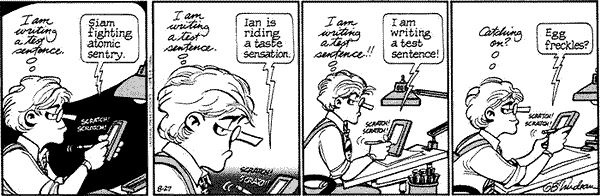
But then I thought, I’d done the same thing in 1994 with my Newton.  We’d sit around in restaurants and pass it around, writing stuff on the screen and seeing what it came back with.  The tough part for Apple was that so were Gary Trudeau and Matt Groening.  The Newton was just ridiculed in Doonesbury and The Simpsons as a result, which was good sport, but unfortunate. 

db930827

From Doonesbury http://www.doonesbury.com/strip/

All the rest of what made the Newton incredibly revolutionary got swept aside, and to a large degree pronounced a premature death sentence on the product line, and the whole category until Palm, and now the iPhone.

So, where are the comics ridiculing Google’s voice search for the iPhone?  A search on the following word salad “google audio search mistakes iphone” yielded a single reference to an article mocking its performance.  Revealing it not surprisingly struggles with accents, and illustrates how it does with various British/scotch/welsh accents speaking the word “iPhone.”  But then again, haven’t the British always been ahead of us in terms of humor?

It is notably ironic that it’s on another Apple handheld device that the limits of the human/machine interface are laid so bare.

But what has happened since 1994.  Have we all gotten more accepting of technology shortcomings?  Have we been just accepted being perpetual beta testers? 

Or are we just intimidated/enchanted with whatever it is that Google (or Apple for that matter) present to us? 

What do you think?

Peripateia and the value of getting it wrong

March 9, 2009

One of my kids favorite TV shows is “Dirty Jobs”, and I have to say that what I’ve seen of it, I have liked, because the host Mike Rowe comes across as genuine and inquisitive.  He’s there to understand, not to judge.  That alone is a wonderful set of values for children to see and explore, regardless of medium.

So, when a friend forwarded a link to Mike Rowe’s TED talk  (embedded below) on the merits of hard work, my intellectual curiosity was high.  His job is to question assumptions and to get all of us to understand the real, human aspects of jobs that other people are unaware of or assume just get done. 

He talks about how he’s “gotten it wrong” a lot, but that getting it wrong informs the essence of what he does and how he does it.  He shares the meaningful failure he encounters as an apprentice on a sheep ranch where it’s his job to castrate the lambs. 

He does his research ahead of time and determines the “humane” way to perform said castrations (with a rubber band).  Then he gets to the ranch, and finds the castration performed there is quite different (with a knife, and more); on the surface a more grisly method than he or we could have imagined.  Let’s just say that this would make killing an actual chicken seem simple and an easy choice.

But in the process of telling the story he introduces the concept of peripateia – the sudden or unexpected reversal of circumstances or situation (remembering it from his days studying Greek classics).  What a wonderful way of describing meaningful failure. 

Mike’s castration dilemma is so clearly framed, his assumptions apparent (“the ‘humane’ way is the right way”) and then, through first-hand experience, not only questions that assumption, he casts it aside when he realizes the definition of “humane” needs to be questioned. 

He describes in twenty minutes what some entrepreneurs I know have taken years to internalize, and he draws on some key themes I’ve explored:

  • Getting it wrong is something you need to embrace, it’s what enables you to both perform better and to comprehend your purpose and goals more insightfully.  It’s meaningful failure from another point of view.
  • You need to know when to stop what you’re doing, and question your core assumptions.  This is hard, as I’ve mentioned in previous posts.  When he stops what he’s doing, he demonstrates incredible integrity and purposefulness.
  • Facing up to the unfamiliar, the unpleasant, is precisely what presents you with the opportunity for discovery and learning, and improving the quality of your results.  This is a benefit of chicken-killing I hadn’t thought about.

But the impact of Mike Rowe’s honesty doesn’t stop there. 

He has a transparent methodology (no takes, no scripts, it’s all real) that underpins the credibility of his “product”.  What I loved about this anecdote is that he even had to question that foundational element of his show; he had to stop the filming because his core assumptions about the subject matter were so precarious.   That takes experience and a confidence in your process and values.  He didn’t rationalize, he didn’t talk about the cost of stopping production, he just did it because he knew he needed to.

Back to peripateia.  That doesn’t exactly roll off the tongue, but what an elegant term to describe how you bring meaning to failure, from getting it wrong. and finding meaning from the doing.  I want Mike Rowe on the board of the next company I fund too.

Finding the chicken killers

February 24, 2009

In early 1996 I was contemplating my next career move, and was taking a serious look at Vivo Software, who had developed the industry’s first software-only desktop video conferencing system.  It was four years old, and had gone through three rounds of financing from some of silicon valley’s premiere VCs.  But what they’d learned was no one really needed desktop videoconferencing back then (ie they were generating no revenue). 

I liked the team a lot, they were being led by an experienced “CEO for hire” who was a well known entity in the venture capital community.  He’d been brought on board along with a new round of financing (Series D!) to take the company in a different direction – to pivot the technology to internet video.  He wanted to know if I would come on as VP of Marketing.  After some serious investigation, I took the plunge.

But the company had been working 80+ hours a week, for four years, and had heard every “success is just around the corner” story under the sun.  And here we were, needing to get them excited about success being just around the corner, again. 

The first day, the CEO and I were in a conference room talking through the plan to get the company going again, and needed to quickly sort out who was up to the task.  He grew up in Texas, and could get to the point with charm and a flair for language that was disarming. 

He looked at me and said “Pete, we need to figure out who the chicken killers are here”. 

“Huh?”  is what I thought, and said with the expression on my face. 

I asked him what he meant.  He said something very simple: “everyone likes to eat chicken, but when most folks want it, they buy it in the supermarket wrapped in plastic.  We need to find the folks who will go out back and kill the chicken themselves because they want it that badly.”

Then I smiled and nodded in acknowledgment.

What he meant was we needed the people who will do the dirty, thankless work, the unpleasant unseen tasks, stuff that most people assume someone else will do for them.  It’s the person who you explain something to, they understand it, and only come back to tell you they it got done.  And they did it differently than they’d planned or expected, dealt with broken commitments, maybe having to do someone else’s job.  They just got it done. 

There were going to be a lot of difficult, unpleasant tasks if we were going to take this embryonic internet video technology and make something of it.  It gave me a new lens to see my team with; I had two in my marketing team, and we had two in the developer group.  It mattered a lot as we restarted the company.

And we did make something of it.  24 months later, we sold the company to RealNetworks (by the time the lock-up expired, the value of our stock increased 10x).  Success really ended up being around that corner, and the chicken killers got us there.

It’s crucial to know who these people are where you work, and in your life, if you’re going to get the big meaningful things done.  I think about this a lot.

My wife is a chicken killer of the highest order.  She can cause incredible, positive structural shifts to be made in the behavior of an organization, can build consensus spanning government and private interests, and can manage complex processes with precision and ease.  She does this by making sure that everything and everyone has been considered, including the very unpleasant, messy things that no one else thinks of or quietly tries to avoid.

At her 40th birthday party, in a restaurant filled with her friends from all across the country, I made a toast to her.  I’d worked with a friend who was a talented artist, and had transformed what I had written into a folding hand-printed and hand-colored card.  At each page, there was a thought or reflection.  Everyone had a copy to follow along with. 

When I came to “She’s a chicken killer – doing the unpleasant, the tedious.  The things that others assume just happen”  I got that same look from the audience that I gave the CEO at Vivo. 

Then I explained what a chicken killer was, and across the room appeared the smiles, and then nods of acknowledgment.

Ask, Tell, Help

February 18, 2009

How often do you encounter a a situation at work where your personal values inform how to solve a difficult/ambiguous situation?

In 1998 I had just joined RealNetworks, and was running the RealSystem G2 launch; it was quite an adjustment professionally.  Real had just acquired Vivo Software where I had been the VP of Marketing, and I now had a much bigger job, with much bigger company ambitions.  G2 was Real’s next generation internet media platform, and was intended to become essentially a multimedia operating system for the web.  We never spoke those ambitions publicly, but they were very, very much the ambitions.

We had the upper hand on the internet a/v market.  Microsoft’s Windows Media Technology (WMT) platform was embryonic and poorly integrated across their vast product/platform landscape.  We routinely pushed the Windows Media guys around like how the New England Patriots pushed their opponents around.

But these were the conditions that provoke a response from Microsoft, and I remember the day we learned that Will Poole had been moved to Windows Media from Internet Explorer 4 – the understanding being the “A” team was now on WMT, the same team that had just crushed Netscape. (The Patriots analogy is eerily relevant here – I’ll save that for another post).

Two years earlier we had licensed RealSystem4.0 to Microsoft, and their players could play back our content up to version 4.0, but not our newest G2 content.  This was intentional and was common practice back then – a way to “provoke” upgrades.  We’d get our broadcast customers to produce audio and video in our newest version, and everyone would need to get the new RealPlayer to access the new content – our players were explicit and helpful about how to do this.

Microsoft saw an opportunity.  They made the Windows Media Player automatically become the default player on someone’s computer for our 4.0 content without telling them, and when it got to our G2 content it stopped and produced an error message.  Microsoft made sure the error message was cryptic (a core competency, apparently), implying there was something wrong with Real’s product, and that was it.  End of the road.

This caused a furor for us and our customers.  Competitive technology geopolitics at Cuban Missile Crisis levels.

So, I got called into a meeting with all the senior execs at Real to sort out what to do.  Our president (at the time) has an incredibly insightful mind, and summarized the problem as if he were explaining it to a child.  “Look, during installation you should ask the user if you can play other media types, then you should tell the user if you encounters one you can’t play, then you should help the user locate a player that can.  Pretty simple stuff.

But he wasn’t talking about a solution to this geopolitical skirmish, he was talking about his values, and applied them to a situation at work.  It was so simple; you ask for something before taking it, you tell people if you have a problem, and you help people.

So, I got tasked with spearheading the Ask, Tell, Help initiative, and spent the next six months rounding up industry support for this, eventually causing Microsoft to sign on.  The legacy is visible today to anyone installing iTunes, Rhapsody, or Windows Media – the application asks you for what media types you would like it to be the default.

I think about Ask, Tell, Help pretty frequently.  It reminds me that my values are my values regardless of whether at work or home, regardless of how charged or ambiguous the situation is.  And keeping clarity about those, and a tight grip on them, enables successful navigation of difficult circumstances.

Don’t you think, or rather don’t you desperately hope, that the folks who had a hand in the mortgage/banking crisis would have made different decisions if they’d have applied their personal values to the ambiguous and charged landscape of credit default swaps?

Bad news should travel faster than good news

February 11, 2009

I love this phrase. It was a core principle of Rob Glaser’s at RealNetworks, and I think I must say it to myself or repeat it to someone nearly every day. It’s simple, true, and universal. It applies to work, life, relationships, everywhere.  It’s a core principle that cements the relationship with my partners.

I also love noticing how other people have internalized this principle. The CEO of one of my companies is an incredibly experienced and pragmatic executive who articulates the essence of this phrase another way: that bad news and good news are just different types of data, and just data.  You can’t make good, sound decisions with only half the data. In fact, you will consistently make poor decisions with half the data.

She creates a culture on her teams of “no cost to sharing bad news, and the more rapidly the better”. There’s a second-order benefit too. By treating bad news as data, you build trust within the team, and you shift the focus off the news, and onto what can be done, and how should the team or person respond.  This is easy to say, and really, really hard to put into action.

It also helps you appreciate good news more lucidly. When an executive only tells me what’s working well, the great forecast, the customer wins, part of my mind spins up, wondering “what’s he/she not telling me, because nothing ever goes well all the time.” It gradually deafens my ability to listen to the good news.

Conversely, when someone walks me through what’s gone wrong or what he/she is struggling with, when we get to the good news, I listen so much more closely, because it’s so much more credible. It also tells me a lot about the executive. I know I’m having a real conversation, that I’m not being sold to. 

But this isn’t just about work, it’s about life.  For example, putting into action with your children follows a similar trajectory.  Once my children entered school, and report cards started coming home, we applied the same approach the CEO at my company has with her team.  My children have been told that “this is just a collection of data that will help you and us understand where you need to apply your attention in the next grading period” and “Let’s not focus on the grade itself, but on whether you and we feel you’re working to your potential”. 

My two oldest are in 10th and 8th grade now, where grades matter a lot, and not surprisingly these two children respond quite differently to reviewing “the data”.  The oldest has found it easier to respond matter-of-factly while her younger brother has been less comfortable engaging in a discussion.  There are some likely “birth order” effects going on here, but those aside, he’s struggled to not be defensive…and it’s not about raw intelligence; both of them are at or near the tops of their classes.

So, last month when reviewing the interim grade reports, my son’s math grade had really taken a tumble, it was clear that he was struggling.  But he so didn’t want to examine why.  He wanted to focus on the courses where he was doing well, and pushed back in ways only a 14 year-old can do about applying some objective scrutiny on the basis of his math grade.  But, I guess he listened more than I realized.

A few days later, he walks up to me and says “I’ve got a big math test coming up, and I think I need help with some of this, I just don’t get it.”  We spent the next two nights working together going through the finer points of the standard, point-slope, and slope-intercept formulas with him. 

It was a lot of work, but the transformation was palpable.  He seemed to have turned this corner and saw/felt the benefit of not judging the data, but using it.  By the time we were done, he was confident and relaxed for his test, and he did just fine, better than he expected.

Then again, of course he did, he got to look at all the data.