Archive for the ‘meaningful failure’ Category

The next big thing

April 7, 2009

“What’s the next big thing?” I get asked this a lot, and a lot of VCs get asked the same question too about what’s the next big trend/device/web-service/… and that always makes for an awkward detour in whatever conversation preceded the question.  The truth is “I don’t know.” And it’s a great answer, because none of us do. 

The next big fill in the blank only becomes apparent in hindsight.  It’s not that I’m not smart nor anyone else who gets asked this question, it’s just that you can’t really tell.  Sure, I’ve got favorites (twitter is now at the top of my list, but I wouldn’t have said that a year ago). 

Remember when Google actually was in beta, in 2000?  It began appearing on people’s desktops where I worked at RealNetworks.  We thought it was cool and efficient, but there were ZERO people talking about it being the next big thing.

Last Thursday’s NY Times had an interesting article about the rising popularity of “netbook” computers, and how these are a big emerging phenomena enabled by a structural technology shift in the computing landscape: we no longer need Microsoft, and probably Intel.  The next big thing?  Maybe.  More on that in a second.  Let’s look at newspapers.

Clay Shirky did a phenomenal job explaining the collapse of the newspaper industry on his blog, pointing out it too results from a structural technology shift – the internet.  Clay references Elizabeth Eisenstein’s book, The Printing Press as an Agent of Change, where she observes that during these technological transformations the only obvious effect in the moment is the destruction of the status quo.  What transcends the status quo takes time to emerge.  Clay sums this up well: “That is what real revolutions are like. The old stuff gets broken faster than the new stuff is put in its place.”

In the case of netbooks, we’re about to see a lot of old stuff get broken, but it’s not clear if netbooks are the transcendent replacement, or just one of the convulsions of the revolution.

But netbooks are significant because they’re exploiting the growing vulnerabilities of Intel (price, performance) and Microsoft (price, legacy support, integration) at the low end in the same way that Apple is (more elegantly) exploiting them at the high end.

Netbooks have traction because they focus on where people spend the majority of their computing time: web-based documents and services, and the consumption of digital media.  That’s it. 

Whether or not someone buys one, netbooks educate the average citizen that GoogleDocs and a browser are all you need, and that MS Office is both irrelevant and overpriced.  My belief is the impact of netbooks will not be felt so much in unit volumes, but as catalysts speeding the unraveling the Office franchise. 

But wait, there’s more.  How much distance will separate the Office franchise “unraveling” from prying MS’s grip off the operating system?  Apple can’t do it, and is smart enough to steer clear of this outcome.  Will Android and Linux be good enough at the low end?

We’ve already seen the indifference that’s greeted Windows7, and the reluctance to even adopt Vista, with people scrambling to stick with XP.  My family did exactly this in February when our five year-old XP home computer died, and we scrambled to find someone who could sell us a new XP machine (we succeeded).  It was an intelligence test.  XP or Vista…hmmm.

Maybe this reveals a nuance to Clay’s “revolution” observation.  Perhaps the path to destruction takes you through the terrain of irrelevance.  What netbooks show us is how irrelevant the once mighty Microsoft and Intel platforms are to the needs of people today.  They may be lucrative businesses but they just no longer point to the future like they used to.  They’ve become what’s broken in the revolution. 

It’ll be exciting to see the new stuff that’s put in place.  I’ll be sure to blog about it, after we all see what it is.
Man On Wire – Best Startup Movie Ever?

April 1, 2009

I saw Man On Wire for the first time in February; I’d read a snippet somewhere about this being the story of the man who tight-rope walked between the two World Trade Center towers in 1974.  And at a certain level, that’s exactly what this movie is about.  It’s exquisite.  The tight-rope walker, Philippe Petit is almost a caricature, his vision and ambition equal parts boundless and focused.  I’ve seen the movie three times now, and each time it’s more revealing.

What viscerally strikes me is how it tells the story of starting up a company.  This is all about having an idea so audacious it’s almost not believable to someone who hasn’t drunk your kool-aid, yet.  It’s about staying focused on the one reason why you will succeed and not the 10,000 reasons why you will fail.

Man On Wire reveals four super-compelling principles that underscore what it’s like to be in a startup, and if you haven’t been in one, it’s a wonderful way to get a sense for what it feels like to be there:

  • A meticulously constructed plan, discarded.  Philippe Petit spent six years planning this act, including building scale models of the towers’s roofs, constructing a tight-rope the same length as the towers in a field, and on and on.  And guess what?  The day of the “coup” huge elements of the plan had to be thrown out, the real world just didn’t cooperate.  This is “why the numbers in your operation plan are wrong” writ larger than life.
  • Repeated visualizations of the outcome.  This is one of the critical mechanisms to ensuring you’re focused on why you will succeed.  Philippe from the moment he learned of the Towers construction, visualized walking between them.  For years and years visualized walking that wire, how he would do it and succeed. This is critical when you only get one shot at an opportunity, like he had. 
  • Significant emotional toll.  Getting something done that’s ambitious, with a visionary leader means you will do things that are difficult and way outside your comfort zone.  You will find out who the chicken killers are, who can be relied on and who can’t, and most importantly what you can rely upon yourself for.  It’s messy and painful, and you will be different as a result of this experience.
  • The fear of not succeeding.  Philippe’s obsession was on success.  Startups are all about being laser focused on why you will succeed, and your only fear is success NOT happening.  I just can’t say this enough.  People who are afraid of failure may very well get great things done, but just not at startups.

For me the most piercing and fiercely honest confession of the entire movie is when Philippe describes the moment when he committed himself to walking that wire.  A simple shifting of weight from the foot resting on the tower to the foot resting on the wire.  Silent and internally deliberate. 

Compare/contrast this with the article in this April’s Outside Magazine about why people participate in risky sports, and profiles BASE-jumper Ted Davenport.  Neuroscientist Russell Poldrack asserts that there are three ingredients to risk taking: desire for adventure, relative disregard for harm, and acting on your desires without fully thinking them through.  That last factor strays way, way too far into the landscape of recklessness and separates Philippe from Ted.  There was nothing reckless about Philippe Petit.  Deliberate, honest, ambitious, meticulous.

So see this movie for the reasons I outline above.  Also, let yourself ask the other questions.  Like “how can someone afford to spend six years planning this”?  How “real world” is that?  We’re not getting the full story here, but it sure is enjoyable. 

Before your Netflix delivery arrives watch Philippe break Stephen Colbert out of character on the Colbert Report, and you’ll hear Philippe describe that moment when he shifted his weight onto the wire.  Mesmerizing.

Failing in Style – Guest post by Jenny Hall, former CEO of Trendi.com

March 16, 2009

Jenny Hall has graciously agreed to a guest post.   Jenny was the CEO of Trendi.com, a social networking destination focused on young women’s fashion that was shut down in October of 2008, and discusses what she learned as a first-time CEO through the startup and eventual failure of Trendi.

This blog focuses on this juncture of success, failure, and finding the meaning from each.  I think you’ll enjoy what Jenny tells us through her first-hand experiences at Trendi.  Thank you, Jenny, for being OpenAmbition’s first guest writer.

——————-

I really don’t like failure, but I know it’s one of the best sources of learning. I learned a lot the past few years working at a startup, and I learned even more as a result of it failing.

I joined Trendi.com in March of 2007 as the head of marketing and I ended at Trendi in October of 2008 as the last employee and CEO. We had investors, a smart team, a fabulous domain name, a popular blog and so much more going for us- so many reasons to succeed– yet we failed. 

When people ask me “what happened?” I usually say we ran out of money. That’s the cop-out answer- running out of money is a symptom of the underlying issues. I think our underlying issues were communication related (unclear communication with each other, of expectations, and with our customers) and experience related (being young, excited, wanting to do it all and getting nothing done.)

I learned lessons from the mistakes we made as a company and my personal mistakes. Of the many lessons learned, these are the ones that stand out the most to me.

Your target audience should be so excited about your product that they’re pushing you to launch, even if it’s crappy when it launches.

I joined Trendi after the founder received funding for his idea. (I know- that never happens! We were lucky.) I talked to my target market occasionally, but didn’t seek their regular input for 2 reasons- 1) I trusted the investors and founder were right in their beliefs that the idea was a winner and 2) I was afraid of the reaction if I discovered we were wrong and proposed changing the concept.

I should have let my market share what they value, even if it differed from what we wanted to create. Sometimes we get caught up in what we’re building, fall in love with it, and fail to realize other people don’t see it the same way. It’s like parents with ugly babies (hey, there ARE ugly babies) that filter out all negative comments because they’re so in love with what they created. Trendi was, in some ways, my ugly baby.

Launching a product your market is begging to use, even with a few rough edges, will have more success than a fully developed site that doesn’t add any value. Plus, you’ll tie your market emotionally to the product. They feel invested and valued and voila- you have your first product evangelists. Furthermore, their input is the ammunition needed when confronting a team, investors, or a board about why a major change needs to take place.

Keep the focus simple and narrow.

Once you know what your audience values, keep your focus only on the features you need. Trendi started out (on paper) as a simple 8-page design. We quickly escalated the site to include a robust back end, picture management system, full social network, etc.

Extra features added time to our launch, increased the burn rate and made the user experience…fragmented. We assumed the users would like what we built only to find out they didn’t like or use all the features and it was difficult for them to figure out the ‘point’ of the site when they arrived.

We over-built Trendi for one main reason: We didn’t have a plan.

Sure, we had some general milestones, but we didn’t have an actionable, communicated business plan. When there is no plan, startup employees turn into hormonal 13 year olds with severe ADD. Anything catches their attention and can change the intended course of action. What are the competitors doing? Why don’t we have this cool feature? Let’s make it pink! No grey! We need a YouTube video STAT! (Get the idea?)

People often ask where our board was during this process and I’m embarrassed to say we didn’t have a formal board. We had our investors who would give us time when they could and we had some friends we would call on informally…but no board to help us keep focus.

Don’t do it just because all the cool kids are doing it.

There were an onslaught of “social shopping” sites in 2006 and early 2007. We jumped onto that trend and while it’s important to know the trends and competitors, it’s more important to figure out what your substantive differentiation is, how that difference adds value and how to make money because of it.

This is a mistake businesses and people make all the time- doing something because everyone else is doing it. Why do we feel more comfortable when we’re doing what everyone else is doing?

I now know questioning the trends and value proposition needs to be done regularly- at least monthly- to ensure the choices made are in the best interest of the company.

Hire only when it’s absolutely needed.

Everyone should be fully utilized before anyone else is hired and increasing the number of employees doesn’t always speed up the launch. For a company like Trendi, we probably only needed a CEO, two developers, and a designer. Ideally the CEO would have been someone who deeply understood the target market, could raise money, inspire the team, and was a stellar marketer, writer or able to contribute another key skill.

Instead, we were almost a year into the project and 15 employees deep before our Angel (who owned the majority of Trendi at that point) stepped in and made a drastic change that involved laying off most of the employees.

Yowza. Hard lesson learned. The team stayed lean and more productive after that.

If it won’t matter in 3 months, don’t spend too much time on it.

We could spend a whole day talking about how our rating system would look or a week bantering back and forth about a press release. I should have asked myself – will this matter in 3 months? If it won’t matter then, why spend too much time on it now? Time is a precious commodity in a startup and should be spent on what matters the most- quickly building a product your customers love.

——-

Funny how our resumes show our successes and we take full credit, yet we leave off the failures and if they come up, we blame others. I wish I could blame Trendi’s failure on other people and circumstances, but I can’t. No startup has it perfect- we all deal with difficult employees, investors and economic strains. I have to accept that as a company we made mistakes, but I also have to look back and accept my personal contribution to those mistakes.

Accepting the personal mistakes hurt my ego. I screwed up and it made me question my ability to lead others, my knowledge as a marketer and my future ability to start another business. But somewhere in facing my failure and accepting these mistakes, I was able to learn how I can be a better leader, new things I can try as a marketer, and that I do have the strength to try again.

I always hope for success and aim high, but I now face failure with a humility and thankfulness I didn’t have before. Ignoring failure only hurts you later- you can stuff it away and try to pretend it didn’t happen, but it’ll bite you in the butt at some point. I know that if I face failure as a teacher (a harsh one, but still a teacher) I’ll become stronger and smarter.

I like tea, Thai food and good happy hours. If you want to join me in Seattle for any of these, email me at jennymhall@gmail.com.

Guest post coming Monday

March 13, 2009

I wanted to let you know that OpenAmbition will be showcasing its first guest post, from Jenny Hall, former CEO of Trendi.com, which was a social networking destination focused on young women’s fashion that was shut down in October of 2008.  Jenny will be sharing what she learned as a first-time CEO through the success and eventual failure of Trendi.

I met Jenny the first time a little over a year ago, when she was trying to raise a Series A financing for Trendi, and for  reasons I explained to her, my partners and I were not able to fund her company.  Jenny touches on a few of the reasons in her post on Monday, but in many respects, what she describes are what many entrepreneurs wrestle with in an emerging but crowded market, where so much is learned in real-time. 

Like with many of the entrepreneurs I am fortunate enough to encounter, she and I have kept in touch, and when she stopped by my office a few weeks ago to tell me about her next startup idea, the subject of Trendi of course came up.  Jenny talked me through some of what she had learned, and how valuable the failure of Trendi had been for her personally (but not painless for her, for her employees, or for her investors). 

When we moved on to discussing her next startup idea, it was inspiring to see how much was informed by what she had learned through Trendi’s failure, how she had embraced what many would have tried to forget or move on from.  And so it seemed like she had a story to tell that the followers of this blog could relate to, find interesting, and hopefully find some meaning in too.

I hope you all enjoy it, look for her on Monday.

Google’s iPhone audio search – Newton redux?

March 11, 2009

Up in the attic of our home I have a small “Apple” museum, where I still keep the MacPlus I bought in 1987, the MacII si my wife and I bought in 1992, and most importantly, the Newton MessagePad 110 I bought in 1994.  For years and years, these just took up space, but this year they’ve come back to mind in interesting ways.

On the occasion of the Macintosh’s 25th anniversary, I brought the MacPlus downstairs and set it up.  I had splurged when I bought it, and got the external SCSI floppy drive.  The expression on my 14 year-old’s face was priceless when I turned it on, and he looked at that small screen and said “how did you ever get anything done on this thing?”.  When I explained there was no hard drive, and showed him the single floppy that contained Microsoft Excel, he looked at me as if I’d told him I did my homework as a kid on the back of a shovel with a piece of charcoal (as Abe Lincoln supposedly did).

But the Newton came to mind last weekend, when we were out at a restaurant with our kids along with three of my 15 year-old daughter’s friends.  Nine of us at a table in a bustling restaurant.  Boredom began to take over with the boys (outnumbered), so my 14 year-old son grabbed my iPhone, and downloaded the new Google app.  He discovered it contained “voice based search”, where you could speak a phrase into the phone, and Google would do the speech-to-text conversion, and provide search results.

Before long, this became quite a game.  The phone was passed around the table, and hilarity ensued when someone spoke one phrase, and Google came back with another.  Here are some examples I wrote down:

  • Steyr A-U-G” (this is an Airsoft BB gun) = “cast iron tub
  • Martini, shaken not stirred” = “mikey ticketmaster
  • And if you need advice in PawPaw Michigan, there’s only one place to go” = “the wandering sons of anarchy, episode 13, full stream

We thought that last one, ‘The wandering sons of anarchy” would make a great name for a band.  In defense of Google, the background noise in the restaurant probably didn’t help things.

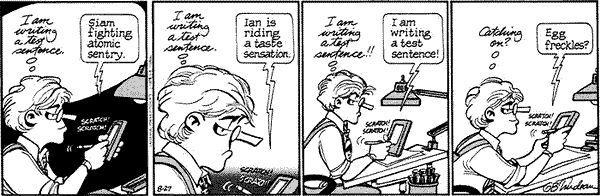
But then I thought, I’d done the same thing in 1994 with my Newton.  We’d sit around in restaurants and pass it around, writing stuff on the screen and seeing what it came back with.  The tough part for Apple was that so were Gary Trudeau and Matt Groening.  The Newton was just ridiculed in Doonesbury and The Simpsons as a result, which was good sport, but unfortunate. 

db930827

From Doonesbury http://www.doonesbury.com/strip/

All the rest of what made the Newton incredibly revolutionary got swept aside, and to a large degree pronounced a premature death sentence on the product line, and the whole category until Palm, and now the iPhone.

So, where are the comics ridiculing Google’s voice search for the iPhone?  A search on the following word salad “google audio search mistakes iphone” yielded a single reference to an article mocking its performance.  Revealing it not surprisingly struggles with accents, and illustrates how it does with various British/scotch/welsh accents speaking the word “iPhone.”  But then again, haven’t the British always been ahead of us in terms of humor?

It is notably ironic that it’s on another Apple handheld device that the limits of the human/machine interface are laid so bare.

But what has happened since 1994.  Have we all gotten more accepting of technology shortcomings?  Have we been just accepted being perpetual beta testers? 

Or are we just intimidated/enchanted with whatever it is that Google (or Apple for that matter) present to us? 

What do you think?

Peripateia and the value of getting it wrong

March 9, 2009

One of my kids favorite TV shows is “Dirty Jobs”, and I have to say that what I’ve seen of it, I have liked, because the host Mike Rowe comes across as genuine and inquisitive.  He’s there to understand, not to judge.  That alone is a wonderful set of values for children to see and explore, regardless of medium.

So, when a friend forwarded a link to Mike Rowe’s TED talk  (embedded below) on the merits of hard work, my intellectual curiosity was high.  His job is to question assumptions and to get all of us to understand the real, human aspects of jobs that other people are unaware of or assume just get done. 

He talks about how he’s “gotten it wrong” a lot, but that getting it wrong informs the essence of what he does and how he does it.  He shares the meaningful failure he encounters as an apprentice on a sheep ranch where it’s his job to castrate the lambs. 

He does his research ahead of time and determines the “humane” way to perform said castrations (with a rubber band).  Then he gets to the ranch, and finds the castration performed there is quite different (with a knife, and more); on the surface a more grisly method than he or we could have imagined.  Let’s just say that this would make killing an actual chicken seem simple and an easy choice.

But in the process of telling the story he introduces the concept of peripateia – the sudden or unexpected reversal of circumstances or situation (remembering it from his days studying Greek classics).  What a wonderful way of describing meaningful failure. 

Mike’s castration dilemma is so clearly framed, his assumptions apparent (“the ‘humane’ way is the right way”) and then, through first-hand experience, not only questions that assumption, he casts it aside when he realizes the definition of “humane” needs to be questioned. 

He describes in twenty minutes what some entrepreneurs I know have taken years to internalize, and he draws on some key themes I’ve explored:

  • Getting it wrong is something you need to embrace, it’s what enables you to both perform better and to comprehend your purpose and goals more insightfully.  It’s meaningful failure from another point of view.
  • You need to know when to stop what you’re doing, and question your core assumptions.  This is hard, as I’ve mentioned in previous posts.  When he stops what he’s doing, he demonstrates incredible integrity and purposefulness.
  • Facing up to the unfamiliar, the unpleasant, is precisely what presents you with the opportunity for discovery and learning, and improving the quality of your results.  This is a benefit of chicken-killing I hadn’t thought about.

But the impact of Mike Rowe’s honesty doesn’t stop there. 

He has a transparent methodology (no takes, no scripts, it’s all real) that underpins the credibility of his “product”.  What I loved about this anecdote is that he even had to question that foundational element of his show; he had to stop the filming because his core assumptions about the subject matter were so precarious.   That takes experience and a confidence in your process and values.  He didn’t rationalize, he didn’t talk about the cost of stopping production, he just did it because he knew he needed to.

Back to peripateia.  That doesn’t exactly roll off the tongue, but what an elegant term to describe how you bring meaning to failure, from getting it wrong. and finding meaning from the doing.  I want Mike Rowe on the board of the next company I fund too.

Finding the chicken killers – part two

March 2, 2009

I got a lot of positive feedback and comments on Finding the Chicken Killers, where I explained what the concept of a chicken-killer was but stopped short of providing an example of one.  Let me tell you about someone who was on my marketing team at Vivo.

[This is a longer post than usual; I hope you find it worth it!]

Ann-Marie was responsible for our online marketing, our website marketing, and our demos at Vivo.  She grew up in a large Italian-American family outside Boston; while she was polite and well spoken, she had a nice independent streak.

The situation was this.  We were now 18 months into the turn-around of the company, marketing our internet video product VivoActive.  We’d become the market leader, but internet video was still small compared to internet audio, and RealNetworks was the big gorilla out there.  Oh, and Microsoft was trying to muscle into the market; they’d recently licensed Real’s product and were giving it away for free (but not really marketing it).  How’s that for being neighborly?

We’d aligned ourselves with Microsoft and could create internet video in their format.  VivoActive together with Microsoft’s server made a complete solution, and we had their marketing and sales teams promoting it to their customers. The plan of course was to get Microsoft to buy us.

The bad news was we were running out of cash (we had about six months left), and we needed to sell the company – remember, we were on a Series D financing.  There was no appetite for a Series E.

So, the CEO, my BusDev director, and I got on a plane and went to Redmond to try and move/force the conversation along, but all we got was a tepid commitment to consider an investment.

We came back from that meeting frustrated and depressed.  The three of us were in our conference room, trying to figure out what to do.  It was almost as if a literal light bulb went off when one of us said “Companies buy their enemies to take them off the market… who are we an enemy of?”

RealNetworks.

Holy cow.  RealNetworks.  Were so aligned with Microsoft; we could be a big threat to RealNetworks.  We had at best an arms-length relationship with them (meaning relations were generally frosty).  How could we get them to feel threatened, really threatened, very quickly?

So, I suggested “What if we let all the RealNetworks customers know they could replace the server they bought from Real with the free one from Microsoft?  All they’d need to do is pay us $500 for VivoActive.”  Hmmm… replace your $50,000 RealServer with a $500 alternative.  That sounded workable.

But how to pull this off?  We needed to quickly find out who was using RealServers and then somehow contact enough of them to make this a credible threat.  I got my team together, and Ann-Marie was the first one to come up with an idea.  “We can use Wired’s HotBot search engine to find web pages with the .ram file the RealServer embeds on pages with the media file, and then find out who the company is that owns those pages.  We can look up who the exec team is at the company and send an email offer to them.”  Great idea, but a lot of work.  She agreed to take the lead on pulling this all together.

Working backward from our cash-out date, we’d need to get this done within the next few weeks.  Otherwise, we’d run out of money in the middle of the negotiations.

Ann-Marie showed up at the next war-room meeting and said she’d gone through the process a few times; it was working, but it was going real slowly.  I suggested she have our receptionist, Amy, help her out.  Away she went.

The next day Ann-Marie came back, deflated.  She and Amy had only been able to build a database of about 50 customers.  This was going to take too long.  More brainstorming.  Ann-Marie offered to see if some of the developers could be pulled off their projects to lend a hand.

The next day everyone was looking haggard and tired.  Ann-Marie showed up, looking worse than any of us. “I was up most of last night.  I realized we’re never going to get this done on time, even with the developers.”

What?

Then she said “But I realized we could do this differently.  I wrote an automated script that queried HotBot and wrote the results into a log file, and then I wrote a script to filter out the domain name of the page where the content was hosted.  I wrote another script to take that domain and query the “whois” database, and found out who the system administrator of the site was, and then put the email address and wrote it into another log file.”  The system administrator was a long way from the guy who paid for the RealServer, but it was close enough.

“It’s working really well; I’m up to about 700 names so far, and should be up to about 2,000 by tomorrow.”

Around the table, jaws were bouncing off the floor.  Ann-Marie hadn’t just killed the chicken, she’d plucked it, dressed it, and had it in the oven, roasting.

We got cracking. It was like a commando movie.  We quickly established a launch date for the emails.  Everyone had their task and took off.  I finished off the copy and reviewed the design of the email.  My busdev director made 1000% certain we had the license agreement in place.

Two days later, we were ready to go.  We briefed the CEO and the rest of the exec team on the plan.  Ann-Marie wrote a script (her new core competency) to send the emails out at midnight.

The next morning we came in, eager to see the results.  By mid-morning we had lots and lots of irate emails from system administrators and, as a result of the system administrators forwarding them, a good portion of similar emails from business execs at companies who were loyal to Real.  Irate was good.  Especially when many of the forwarded emails also copied the account manager at Real or even Rob Glaser, Real’s hyper competive CEO.

Lots of tension; everyone ate their lunches at their desks.  A little after 1pm, our CEO came walking down the hallway, a huge, huge grin on his face.

“Rob Glaser just called.  They want to talk about buying us.  I’m heading out to Seattle, tonight.”

I kid you not, it unfolded that cleanly.  A little over twelve hours after sending those emails.

By the time the acquisition was complete, our CEO was neck deep in chickens, killed.  But Ann-Marie was the one who so matter-of-factly and so fearlessly got that first chicken out of the way, and made it all possible.

Finding the chicken killers

February 24, 2009

In early 1996 I was contemplating my next career move, and was taking a serious look at Vivo Software, who had developed the industry’s first software-only desktop video conferencing system.  It was four years old, and had gone through three rounds of financing from some of silicon valley’s premiere VCs.  But what they’d learned was no one really needed desktop videoconferencing back then (ie they were generating no revenue). 

I liked the team a lot, they were being led by an experienced “CEO for hire” who was a well known entity in the venture capital community.  He’d been brought on board along with a new round of financing (Series D!) to take the company in a different direction – to pivot the technology to internet video.  He wanted to know if I would come on as VP of Marketing.  After some serious investigation, I took the plunge.

But the company had been working 80+ hours a week, for four years, and had heard every “success is just around the corner” story under the sun.  And here we were, needing to get them excited about success being just around the corner, again. 

The first day, the CEO and I were in a conference room talking through the plan to get the company going again, and needed to quickly sort out who was up to the task.  He grew up in Texas, and could get to the point with charm and a flair for language that was disarming. 

He looked at me and said “Pete, we need to figure out who the chicken killers are here”. 

“Huh?”  is what I thought, and said with the expression on my face. 

I asked him what he meant.  He said something very simple: “everyone likes to eat chicken, but when most folks want it, they buy it in the supermarket wrapped in plastic.  We need to find the folks who will go out back and kill the chicken themselves because they want it that badly.”

Then I smiled and nodded in acknowledgment.

What he meant was we needed the people who will do the dirty, thankless work, the unpleasant unseen tasks, stuff that most people assume someone else will do for them.  It’s the person who you explain something to, they understand it, and only come back to tell you they it got done.  And they did it differently than they’d planned or expected, dealt with broken commitments, maybe having to do someone else’s job.  They just got it done. 

There were going to be a lot of difficult, unpleasant tasks if we were going to take this embryonic internet video technology and make something of it.  It gave me a new lens to see my team with; I had two in my marketing team, and we had two in the developer group.  It mattered a lot as we restarted the company.

And we did make something of it.  24 months later, we sold the company to RealNetworks (by the time the lock-up expired, the value of our stock increased 10x).  Success really ended up being around that corner, and the chicken killers got us there.

It’s crucial to know who these people are where you work, and in your life, if you’re going to get the big meaningful things done.  I think about this a lot.

My wife is a chicken killer of the highest order.  She can cause incredible, positive structural shifts to be made in the behavior of an organization, can build consensus spanning government and private interests, and can manage complex processes with precision and ease.  She does this by making sure that everything and everyone has been considered, including the very unpleasant, messy things that no one else thinks of or quietly tries to avoid.

At her 40th birthday party, in a restaurant filled with her friends from all across the country, I made a toast to her.  I’d worked with a friend who was a talented artist, and had transformed what I had written into a folding hand-printed and hand-colored card.  At each page, there was a thought or reflection.  Everyone had a copy to follow along with. 

When I came to “She’s a chicken killer – doing the unpleasant, the tedious.  The things that others assume just happen”  I got that same look from the audience that I gave the CEO at Vivo. 

Then I explained what a chicken killer was, and across the room appeared the smiles, and then nods of acknowledgment.

Bad news should travel faster than good news

February 11, 2009

I love this phrase. It was a core principle of Rob Glaser’s at RealNetworks, and I think I must say it to myself or repeat it to someone nearly every day. It’s simple, true, and universal. It applies to work, life, relationships, everywhere.  It’s a core principle that cements the relationship with my partners.

I also love noticing how other people have internalized this principle. The CEO of one of my companies is an incredibly experienced and pragmatic executive who articulates the essence of this phrase another way: that bad news and good news are just different types of data, and just data.  You can’t make good, sound decisions with only half the data. In fact, you will consistently make poor decisions with half the data.

She creates a culture on her teams of “no cost to sharing bad news, and the more rapidly the better”. There’s a second-order benefit too. By treating bad news as data, you build trust within the team, and you shift the focus off the news, and onto what can be done, and how should the team or person respond.  This is easy to say, and really, really hard to put into action.

It also helps you appreciate good news more lucidly. When an executive only tells me what’s working well, the great forecast, the customer wins, part of my mind spins up, wondering “what’s he/she not telling me, because nothing ever goes well all the time.” It gradually deafens my ability to listen to the good news.

Conversely, when someone walks me through what’s gone wrong or what he/she is struggling with, when we get to the good news, I listen so much more closely, because it’s so much more credible. It also tells me a lot about the executive. I know I’m having a real conversation, that I’m not being sold to. 

But this isn’t just about work, it’s about life.  For example, putting into action with your children follows a similar trajectory.  Once my children entered school, and report cards started coming home, we applied the same approach the CEO at my company has with her team.  My children have been told that “this is just a collection of data that will help you and us understand where you need to apply your attention in the next grading period” and “Let’s not focus on the grade itself, but on whether you and we feel you’re working to your potential”. 

My two oldest are in 10th and 8th grade now, where grades matter a lot, and not surprisingly these two children respond quite differently to reviewing “the data”.  The oldest has found it easier to respond matter-of-factly while her younger brother has been less comfortable engaging in a discussion.  There are some likely “birth order” effects going on here, but those aside, he’s struggled to not be defensive…and it’s not about raw intelligence; both of them are at or near the tops of their classes.

So, last month when reviewing the interim grade reports, my son’s math grade had really taken a tumble, it was clear that he was struggling.  But he so didn’t want to examine why.  He wanted to focus on the courses where he was doing well, and pushed back in ways only a 14 year-old can do about applying some objective scrutiny on the basis of his math grade.  But, I guess he listened more than I realized.

A few days later, he walks up to me and says “I’ve got a big math test coming up, and I think I need help with some of this, I just don’t get it.”  We spent the next two nights working together going through the finer points of the standard, point-slope, and slope-intercept formulas with him. 

It was a lot of work, but the transformation was palpable.  He seemed to have turned this corner and saw/felt the benefit of not judging the data, but using it.  By the time we were done, he was confident and relaxed for his test, and he did just fine, better than he expected.

Then again, of course he did, he got to look at all the data.

Heartbreak and principles

February 7, 2009

Sometimes what we work so hard to accomplish and produce, even in the face of relevant experience and exquisite talent, just doesn’t materialize. How sad to view that as failure. Or rather, how sad to view the outcome as the only measure of success, when you have the opportunity to measure success by examining how you are working along the way.

One of my favorite short stories is “Ball of Fat” by Guy de Maupassant. It concerns a group of six citizens fleeing the oncoming Prussian army by stagecoach, attempting to find safety in a town far away. One of the characters is a plump prostitute nicknamed “Ball of Fat”. The others in the carriage are a range of upstanding citizens who view her with equal parts contempt and curiosity.

As they make their way the group gets hungry. The other five become irritated and cranky, hoarding what little food each has brought. Eventually Ball of Fat produces a veritable travelling feast, and generously shares the food she’s thought ahead to pack. A change in her status takes place, that day’s journey ends with the group treating her almost as an equal.

They don’t make the progress they expected, and have to stay the night in a town that they discover is occupied by the very army they’re fleeing. Circumstances are dire. Will they be held for ransom? Imprisoned? It turns out Ball of Fat is well known to the commander, and when he indicates he will set them free in exchange for an evening with her, the group takes a principled stand protecting her. But time wears on, and it becomes clear there is only one way out of this town. So Ball of Fat, against the protests of her carriage-mates, agrees to this bargain for the good of the group.

In the morning, all is well, the carriage is provisioned, and the group boards, but unlike the sense of shared destiny of the day before, the group shuns Ball of Fat, passing severe judgment on a woman who would “sell” herself. The atmosphere is cold and harsh in the carriage. They make their way along, and members of the group get hungry.

This time the others have planned ahead, and produce a wonderful array of food. Except Ball of Fat, she had no time to think about food (she was busy securing their freedom).  But no one offers food to her, in fact, food is shared liberally to everyone else, but her. The scorn heaped upon her is overwhelming. She slowly begins sobbing. The story ends.

Well, one reaction is “jeez, how bleak and sad”.  But is it really?  Ball of Fat acted generously and bravely, with a clear sense of herself and her values. She made her way through uncertain and ambiguous circumstances making clear decisions and tradeoffs based on principles that were transparent and honest.

My former assistant thought it was “the worst blog idea she’d ever heard”. And she’s partly correct. The message – it’s not about the destination it’s about the journey – is obvious and well trodden. Except because it’s so familiar, I think we spend a lot less time examining this than we would like to admit.

It’s easy to focus on the journey when the terrain is familiar, with familiar unpleasant junctures.  But when truly severe shocks occur, it can be hard to hold onto those principles to guide you. 

This is why I love working with people who have experienced spectacular failures.  You learn a lot about yourself and those around you when the product you’ve been developing and counting on doesn’t work and you miss your revenue plan, strain or destroy customer relationships, and all you know is only time and more hard work will solve the problem.  How you respond then matters a great deal.

Because Ball of Fat is so heartbreaking, it’s too easy to focus just on the heartbreak, and not on how she navigated the heartbreak.  Those principles produced honest and generous responses in the face of stingy and uncomfortable circumstances.  There’s no heartbreak in that.