Posts Tagged ‘Intellectual curiosity’

How a BMW 2002 taught me the true value of experience

January 7, 2025

By Peter Zaballos

The first car I bought out of college was a 1972 BMW 2002. I grew up in California, in the Bay Area. That part of the world was awash in amazing sports cars, and I was deeply obsessed with them. That 2002 in hindsight was a brilliant choice — it’s now a highly sought-after classic.

Years and years later, deep into my career as a full-grown adult, I learned to embrace the value of “lots of inexpensive failures” as the key to gaining insight and experience. Let’s just say that, to my “barely adult” me back then, the 2002 must just have been the embryonic moment when this belief took root.

I got the car shortly after taking a job at LSI Logic (see earlier posts on that company here, here, here, here, and here) and simply needed reliable transportation.

Where “reliable” is more properly defined as “fun, sporty, functional, and reliable.”

I grew up in a household where my dad saw cars as nothing but transportation and utility – he cared nothing about design or driving experience. In fact, when he bought our family station wagons, he told us his opening line with the car salesman was “show me the cheapest car you have on the lot.” 

Not surprisingly, there was an awful lot of daylight between his view of the role a car could play in one’s life and my one.

But something I knew for certain was that the BMW 2002 was a glorious car. I saw them every day in and around Berkeley. The car is beautifully designed, with a near indestructible engine and transmission. It handles with precision and grace, and overall it’s one of the most lively, fun sports cars you will ever drive. It also served to clearly establish BMW as the sports car and sports sedan powerhouse it is today. The 2002 literally cracked open the US market for BMW.

And I’d been lusting after one of these for years.

I forget where I bought my 2002, but it was tan — how did I choose that color? — with a chocolate brown interior. An uninspired choice I would rectify much, much later in life.

Here’s a 1972 BMW in that awful color (not mine… mercifully I did not keep any photos of it)

Once it was in my hands, I immediately set to upgrading it. I had never worked on a car before, so this was a big, generally fun adventure. 

My resources? Back then there was no internet. You had to go to the auto parts store and buy a printed manual for your car, like the Haynes Manual. The manual for my car covered six models, spanning 18 years. So let’s just say that for any particular model and year, the information was broad, but thin. The book, after all, was a little over two hundred pages. Maybe fifty pages for each model. Yep, broad but thin.

For the next two years I replaced or upgraded almost every moving part on that car. I worked on it during the weekends, since I had to drive it to work on Monday. This created a few somewhat stressful Sundays and some profound learning moments.

Like when I replaced the Solex carburetor that the factory provided with a higher performance Weber, marveling at the beauty of that device when I picked it up at the auto parts store. 

Solex Carb Comparison with a Weber Carb (now including gaskets!)

I quickly took it home and got to work, removing the Solex, unplugging the vacuum hoses and throttle cable, scraping the intake manifold mounting area clean and then… realized I did not order a new gasket. Hadn’t thought about that. It was now after 4pm on Saturday. I borrowed my parents’ car and headed to the car parts store in a mild panic.

There I learned that car parts stores don’t stock gaskets for Weber carburetors — especially for obscure German cars — so I would have to order one, and it would be in by the next weekend. Oops. I kept my parents’ car that week. The following week, with gasket in hand, I mounted it and the Weber on the manifold and bolted it in place. But wait, there’s more.

Re-attaching the throttle cable was easy. But those vacuum hoses? I hadn’t labeled them when I took off the Solex. Oops.

This was decades before the internet, and the Haynes manual did not have diagrams for Weber carbs. The factory shipped them with Solexes, so that was the diagram in the book. And you can see that diagram was no help. 

I did my best, but the engine ran a bit rough — I had clearly misconnected something. 

Luckily there was a wrecking yard in the industrial flatlands of Berkeley that specialized in BMWs. I headed there, and the guy who ran the place, who was in his late 20s, opened the hood and within minutes “cleaned up the vacuum hose hygiene.” I remember that place was loaded with 2002s, Bavarias, and even a few 3.0 CSs. Today those cars — especially the 3.0 CS — are simply unobtanium. To think there was a wrecking yard containing just those cars is incredible.

Later in my car upgrading journey I got new shock absorbers for the front and rear suspensions. I started with the front: I read the manual and realized I would need to get a spring compressor to replace the McPherson strut cartridges. I headed to the auto parts store and rented one for the weekend.

And of course the Haynes manual had diagrams for the front suspension but no real instructions for how to disassemble it and replace the shocks. I spent the better part of eight hours sorting all this out and successfully replaced the right front shock. 

And with everything I learned from that right front unit, I was able to make quick work of the left one, replacing it in under an hour.

I did not have enough time that weekend to swap out the rear shocks, which were super easy. I could do that next Friday after work, before heading up that same night to Lake Tahoe to go skiing. 

This work is pretty straightforward: after you jack up the rear of the car, it’s fairly easy to access where the shock is attached to the lower trailing arm of the rear suspension via a single bolt. The other end of the shock absorber is attached at the top of the top of the “shock tower” through the rear body sheet metal, also with a single bolt. That top bolt is accessed through the trunk, where it protrudes. 
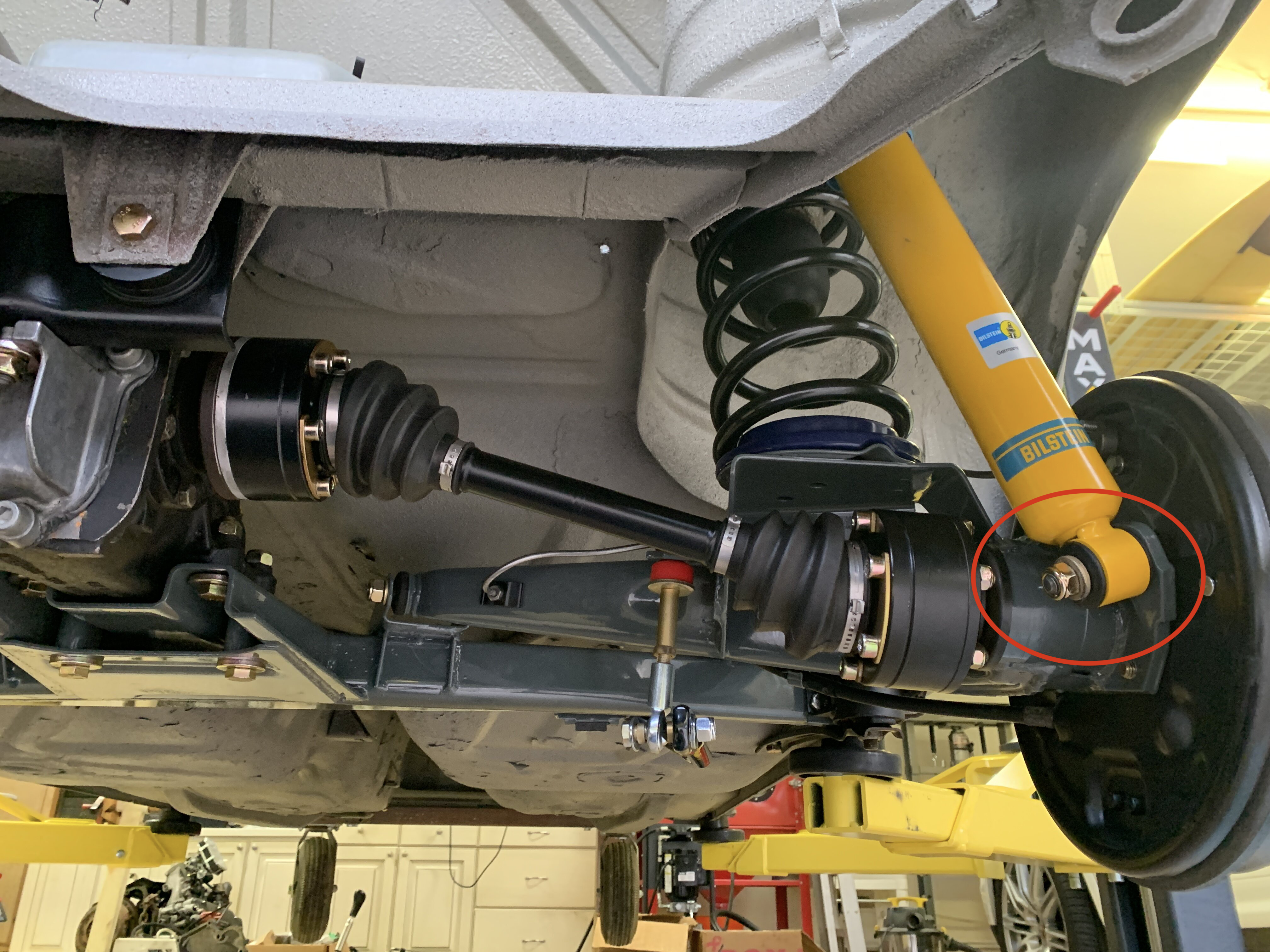
Super easy. I left work early to get home a little before 5pm, and by 6:30 I was on the road to Tahoe. It was dark by the time I left heading out on Highway 80 for the four-hour drive.

As I approached Auburn, I started to hear a knocking from the right rear of the car. I figured I could deal with that when I got to the condo I had rented for the winter. As I approached the mountains outside Auburn, it had started to snow lightly. By the time I was approaching Donner Pass, the snow was less than an inch and not sticking, so nothing to worry about.

But that knocking from the back was getting worse. So I pulled over, got a flashlight and looked into the right rear wheel well and could clearly see that the shock was banging around in the shock tower because I must not have tightened the second lock nut at the top of the shock tower, so both it and the securing nut had vibrated off. I opened the trunk and found the two errant nuts — at least now I could get everything put back together.

First I would need to jack up the right rear of the car, take off the wheel, get the shock back in place, and make sure I put everything else back together.

And as everyone who works on cars knows, the way you take a wheel off a car is to first loosen the lug nuts before jacking it up. It makes it so much easier to get the force you need on the lug wrench and eliminates the risk you’ll pull or push the car off the jack. And you reverse this when putting the wheel back on.

So I loosened all four lug nuts, got the car up on the jack, and went to work.

I was able to get the shock absorber positioned at the top of the shock tower and pushed the top through the mounting hole. My hands were getting pretty cold by then, though. You see I had plenty of skiing gloves, but nothing light enough to do this kind of car work, so I was working bare-handed. It was past 10pm and well below freezing.

I ran around to the back of the trunk, threaded the nut on the protruding shock absorber mounting bolt, and tightened it down, hard. By now my fingertips were getting numb.

I put the wheel back on the car as quickly as I could, threaded the lug nuts on and tightened them, lowered the car off the jack stand, threw all the tools in the trunk, closed it, hopped in the driver’s seat, closed the door as fast as I could, and cranked the engine over, pushing the heat lever to full on and the fan as well. My hands were frozen.

I got back into traffic, and pretty soon I was headed on my way, up and over Donner Pass.

Just after cresting the pass, headed downhill, I felt the right rear of the car drop with a loud CLUNK. I looked in the rear view mirror and saw a rooster tail of sparks arcing into the air behind me. And to my right I saw a wheel rolling past me, getting further away the more quickly I slowed down to stop.

Once the car stopped, I got out and ran around the back to see that the wheel I saw heading down the road was, in fact, my right rear wheel. Those sparks were the suspension scraping the pavement.

Holy crap, I forgot to tighten the lug nuts when I lowered the car off the jack. So I had sped off with loose lug nuts, and the nuts must have slowly worked their way off the lugs.

This was before cell phones existed. The thoughts going through my head then were pretty dire. 11pm on a Friday night, in the Sierras, light snow falling. In need of a tow. But then what? Where was I going to find a spare rim and tire for a 1972 BMW in Lake Tahoe?

Remember, this was the mid 80s, decades before BMWs became mainstream. As important, decades before tech bros took over Tahoe with their BMWs.

So I had no choice. I got out my flashlight to see if I could find… anything.

To the right of the car, the side facing away from traffic, I could just barely see a thin trail in the snow — the trail my tire had made as it fled my car. I followed the trail like a hunter tracking an elk, down the road and down the hillside.

Lo and behold, there it was, resting on its side. Easy to spot, with the light flickering off of those distinctive “bottle cap” wheels I had upgraded to.

I grabbed that puppy, triumphant, and hauled back up the hillside to my car.

But the lug nuts. There’s no way I was going to find those. Not only could they have come off one-by-one over a mile or two, they were the same color as the pavement. And while I had some spare parts with me, no one keeps spare lug nuts.

Then I did the math and realized I had twelve lug nuts on the three remaining wheels. If I took one off each wheel, I’d at least be driving with equally compromised wheel integrity.

So I backed one lug nut off each of the three remaining wheels, got the errant wheel attached with the three lug nuts I had just harvested, and was on the road again.

Ah, to be young and carefree. 

I got to my rented condo well after midnight, and the weekend unfolded as planned. I spent two full days skiing with my crazy friends, and I mean crazy — we liked to jump off the cornice to the left of the Headwall chair at the resort that is now known as Palisades. More on that at a later date.

I drove home feeling somewhat triumphant, having averted disaster while having an awesome skiing weekend. Monday I went to the auto parts store and picked up four lug nuts. Why just four? That’s all I needed, obviously. I would never do something dumb like that again.

Here is the orange 1973 2002 I bought a few years ago. With this car I corrected my poor color choice of my first 2002 and bought one someone else spent their time and energy fixing up. Absolutely crazy fun. 

Everyone should own a 2002. What other car can provide this much adventure and offer so many ways to gain experience? Where experience is “the disaster that didn’t kill you.”

What I’ve Learned Over a Career

September 19, 2019

By Peter Zaballos

Reflections Upon Retiring

I have officially “stopped working,” which is a way of avoiding saying I have retired. I’m still active on two technology company boards. Still very much on a number of near-vertical learning curves.

But leaving my professional role has caused me to look back. And looking back, it’s easy to see and feel what was meaningful — and what wasn’t — in 30+ years of building high-growth technology companies. Let’s start with what wasn’t.

What wasn’t meaningful were the financial and business milestones I had a hand in achieving,  because business metrics are outcomes — of strategy, execution, and culture — but they aren’t the end in themselves. They’re the means to an end. I helped three companies change the very shape of computing, and only one of these companies — LSI Logic — had the winning trifecta of brilliant strategy, incredible execution, and a culture of compassion and performance. C-Cube Microsystems and RealNetworks failed miserably on culture.

And along the way I met some incredible, incredible people. People with staggering intellect and, most importantly, people with huge hearts and abundant generosity. But I also met a lot of people with none of those qualities. And who seemed to become quite successful as well. That was puzzling and frustrating.

And the long hours I put into my different roles? Not a lot of meaning there. As a matter of fact, the further into my career I got, and the higher I rose in the executive ranks, the more jaded I became at the devotion to long hours. 

I wish I could have told this to my younger self, especially when my wife and I were in the thick of raising four children born over a span of five years. A few years ago, when I was at SPS Commerce, I heard a sales rep tell a group of people they had cut their honeymoon short by two days, at the insistence of their manager, to attend a meeting. As I sat there I thought — with the benefit of hindsight — that no meeting would be worth cutting your honeymoon short.

[And it told me about the real culture at that company. Not the one written down. More on this topic further down.]

And on a related note, I also grew weary of the need to always being “hard core” about competing, about winning, almost for winning’s sake, of what in the end were ephemeral competitions.

But when I think back to what was meaningful, it really came down to this: being in a position of power and authority to create the conditions where the people that worked for me could do their best work and discover their best selves. To set the tone, to shape the culture. To be able to actively work to achieve equality in the departments I led. And to be a voice on an exec team pushing for equality across the companies I worked at.

Equality created lasting effects for the people on my teams, and is the polar opposite of a business metric. The people on my teams were able to achieve and exceed business metrics/targets because they could be valued for their contributions. 

The first time I noticed inequity in a specific case was when I was at RealNetworks in 1999 — having joined through their acquisition of Vivo Software — and I inherited a department to run. The first homework I gave myself was to look at compensation across my teams, by role and by gender. I discovered one woman was paid substantially less than her male counterparts. 

It took almost a year of fighting process and bureaucracy to “true-up” this woman’s compensation. And it started me doing a similar analysis in every leadership role I had after that. But that was super tactical, from ground level looking skyward.

I think the first time I realized the impact I could have on equality and culture from the top down was when I wrote my first user manual when I was an exec at SPS Commerce. This simple document simply outlined what I expected of myself, my peers, and the people on my teams. 

Feel free to check out my User Manual

It was the act of writing this document where it dawned on me that not only did I have the ability to set a tone of equality in the orgs I led, but that I had an obligation to my teams and to myself to do so. I was literally kind of giddy over the next few months.

The flip side is that it was sobering to realize how much opportunity I took for granted as a man that women had to work for, fight for, or just resign themselves to never having. And I discovered this because once it became clear for my teams that our values and culture were real, the results were shocking:

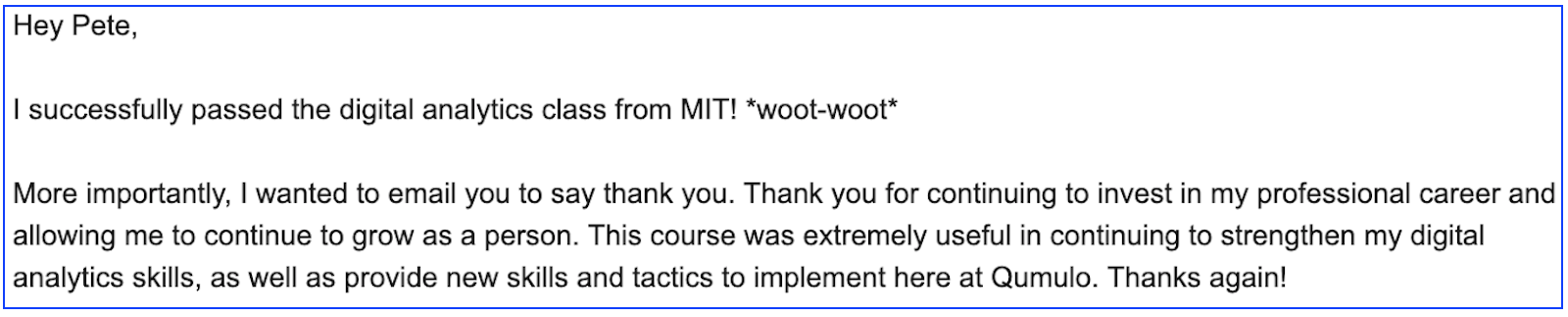
  • That the  woman on my team (quote is above, sent to me and her manager) thanked me for making her feel comfortable and empowered to take time off to attend her kindergartner’s graduation.
  • I have had a woman tell me I was the first executive to tell her that taking care of her health in her very stressful role is more important than her job.
  • I have had a male boss ask me, every single time a woman on my team was pregnant, “Do you think she’s going to come back after maternity leave?” He never once asked me that question about any of the men on my team whose wives were pregnant.
  • On the day when we finally (after weeks and months of proposing this) had “equality” on the exec staff agenda, I had our male CEO open the discussion with “Well, I assume if we had an all-female leadership team that would be sexist.”
  • I have seen women on my teams treated like servants by men who were their peers — asked to literally get coffee for the men or rebook their hotels with better rooms when they were traveling as a group.

I have also seen people make amazing contributions and incredible achievements in their roles, when provided the conditions to be their best.

  • I witnessed a shy, unsure of-herself customer service rep make the huge leap into product management and then, over a period of 18 months, turn into a bad-ass, decisive, confident product manager responsible for more than half the company’s revenue.
  • I witnessed a woman who had previously sold cell phones at a Verizon store become a master of marketing and digital demand gen and, as a result, was headhunted to be a marketing executive at another high-growth technology company today.
  • I had the good fortune to hire two phenomenally talented product designers, one in his first role designing software. And by giving these people the freedom to follow their creative instincts, create a culture of design excellence that produced truly delighted users of their products.
  • I witnessed a two-member team apply record-breaking amounts of curiosity to become masters at digital marketing through constant reinvention and data-driven refinement. 
  • I hired a brilliant person from a shoe company into his first full role in marketing. He left a year later to go back to the shoe industry and has so far reinvented two blockbuster, multi-billion dollar international footwear brands.
  • My partners at Frazier Technology Ventures – Len Jordan, Scott Darling, Paul Bialek, and Gary Gigot – discovered that when we stripped away our egos we could have direct, blunt conversations about decisions we were making. This set the standard for me valuing the lack of ego as a chief hiring criteria.

What have I regretted? Well, I mentioned above, working long hours in the end just took time away from my family, and I really can’t point to a meaningful source of business satisfaction that makes up for that. Other regrets:

  • That I did not listen to that little voice inside me when I had to fire people — or ask them to leave — because they were not performing or were not able or willing to live up to the expectations for conduct I had for them. That little voice said to go the extra mile, to fight with HR and in some cases the CEO, to get these people a package that would let them leave gracefully.
  • That I did not listen to that little voice inside me and instead followed the advice of others in letting people go with the bare legal minimum in notice, disclosure, and dialogue. I expect those people left my departments feeling they were not treated with the respect they deserved, and earned, through trying as hard as they could.
  • That I did not put my own job at risk more often pushing for more equality as a company, pushing the CEO and leadership team to take a more difficult but right path. This is where hindsight really stings — when I can see I was right but was afraid or buckled under pressure.

What else I’ve learned along the way:

  • Your brand – personally and as a business – is built on how well you say “no.” You say no 10 time more than you say yes. Doing a good job saying no means you are creating 10 times as many positive word-of-mouth evangelists. It also means you keep your focus on empathy and humility.
  • And since you say no much more than you say yes, you’ll spend time with people who you won’t say yes to. Learn to give more than you take when you do this. Help them some other way. Introduce them to someone else who can help. Offer wisdom and experience.
  • Treating people well on the way out the door is as important as it is rare. Being generous to people you fire, who decide to leave to advance their career, or who are just not a good fit matters. A lot. It is shocking how rarely I have been supported by HR leaders and CEOs on this topic.
  • How a company treats the behavior of their salespeople and developers defines the culture, not the “values” that are written down. I have seen sales people lie (to customers, to me, to other employees) but suffer no consequences because they “deliver.” Same for developers. That corrodes the culture and causes the high-value talent to leave.
  • How a company handles equality defines the culture, again regardless of what “values” are written down. It takes real bravery to foster equality in a culture. It is always easier to let fear cause a company to tolerate harassment. We need more bold, brave leaders. We absolutely need more women leaders. And leaders of color. And leaders from other cultures.

So at the end of this phase of my professional life, I would say that what mattered, what was meaningful, what was important was creating conditions for people to be their best selves. And that how you treat people matters, enormously.

What’s next for me? I’m on the board of two tech companies in Boston and am for sure going to continue stay on steep learning curves there. 

And my wife and I are launching the Diamante Scholars program at Diablo Valley College (the community college I attended)  to help under-performing, high-potential students find their path (more on that in an upcoming blog post). 

I’m attending community college myself to learn Spanish. 

And I am learning to drive race cars

But most of all, I am going to keep learning to be better. At everything I do and am. If I learned anything from 30+ years building high-growth tech companies, it’s that you can always be better. You can always learn.

Looking through the turn

June 24, 2019

By Peter Zaballos

I recently started learning to drive a race car, something I’ve always dreamed of doing. 

With the encouragement and support of my wife and all four children, I began taking high-performance driving classes at one of the best driving schools in the country, in Kent, Washington. And I wanted to share what I am learning there, because I’ve discovered that driving a car fast on a race course is a lot like making your way through a career or through life.

When you’re driving a race car, one of the first skills you learn is to “look through the turn.” It’s the habit of having your eyes focused on where you want the car to go, not where it is right now. And it’s super pragmatic. 

When you’re driving a car at high speed, whatever is in front of you is coming at you so fast that if a correction is needed, that correction needed to take place seconds earlier. You literally can’t fix the problem at that point. When your eyes are focused on what’s directly in front of you, it’s called “driving from the hood of the car.” Best case, you’re going to exit that turn slowly, poorly positioned for the next turn. Worst case — you’re going to drive off the track.

So you’re instructed to split your field of view, with the majority of your vision focused far down the road and only your peripheral vision tracking the close-up things. Sometimes that turn ends over your shoulder, so you go into the turn literally looking out the side window while the car is barreling forward through the turn.

And it gets harder still because you really do need to keep track of close-up things coming at you. There is a point where you need to start the turn — called the “turn-in-point” — where you stop going straight down the track and you turn the wheel. You need to do your braking before this point because you can’t brake hard and turn at the same time (and you need to brake hard to get your speed down).

When you turn in, you need to arc the curve of your path to hit the part of the corner that will produce the largest radius turn you can trace — a larger radius means higher speed — so you are also tracking for that critical spot that ensures you are carrying the maximum speed through the turn. You need a telltale mark for this “apex” point.

Finally, as you exit the turn you need to aim for a spot that finishes that largest radius turn you initiated way back at the turn-in-point. This is called the “track-out” point.

And this is not just about that one turn you just negotiated. It’s about considering the entire track and all of its turns and how you think about what will produce the lowest overall time through the course. It could very well hurt your overall lap time to go through a particular turn super fast, because it could send you into the next turn poorly positioned.

At driving school, there’s a traffic cone conveniently placed at the turn-in, apex, and track-out points. But in racing — as in life, of course — there are no cones at these telltale points.

So for every turn on a track, you need to memorize some physical object — a visible patch of dirt, a tree on the horizon, even a porta-potty off to the side of the track — to help you know when to turn in, where the apex is, and where to end your turn. The chief instructor of the school, Don Kitch, has raced in the 24 Hours of LeMans, and said it took him and his two co-drivers a year to prepare for it. They took hundreds of photos so they would know the key telltales of every turn on the track.

Everything I just described about learning to drive a car on a racetrack is also true of navigating your career and living your life. Keep your vision fixed on the long term, but be intentional and precisely aware of the tell-tales along the way.

From a career perspective, every turn on the track is like each job or role you have. The goal is to decide when to take that job, how to maximize your “radius” through it so that you construct the most impactful and rewarding career, and when to “track out” for your next opportunity. 

It’s not about maximizing the results from any one role, but being very intentional about how your progression of roles link and make sense together. It’s why focusing just on compensation or a title for that next job may not, in fact, set you up for the role you really want, two or three career moves later.

So, on the track and in your career, look through the turn.

Why the numbers in your operating plan are wrong

December 9, 2008

Startup companies begin life with operating plans – the spreadsheets that outline how revenue will be generated and expenses will be allocated. But in the end it’s all a very well calculated guess. So much is unknown.

A phrase I use a lot when I meet with startup companies is “the only thing we know for certain about your plan is that the numbers in it are wrong”.   It’s a disarming statement, it generally sets everyone at ease.  How could you possibly know what your revenue will be in month 33, when you haven’t even shipped your first product?

And it’s true, in a good way. It’s not the values in the cells that are important, but the set of assumptions and principles that underpin the numbers in the cells that are. I mentioned this in my first post. It sounds and is obvious.

Why bother with the plan? Some CEOs I meet take this path, and use their operating plan as a “check off the box” deliverable on the way to getting funded. But if you go there I think you blow right by critical insight about your business. You need that plan, even when you are far off it, to help you understand which assumptions are still valid, and which may need to change.

An example of an assumptions is “we’ll have larger companies distribute our product for us, and each company will deliver 50,000 end users to us”. That’s important to remember, especially if after six months, they’re only delivering 5,000 users.  It’s even more important to understand if this is just a factor of how long it takes to ramp demand (in which case that assumption needs scrutiny) or of it’s because that’s all the demand these companies can produce for you (ditto).

Your plan is a tool that has a limited useful life, at some point your business (and assumptions) change so much you need to pull out (or rather create) a new one. The right tool, for the right circumstances matters, a lot.

If the right tool is critical, the right mindset produces it. Successfully running a startup requires a resilient open mind and cultivating a sense of intellectually curiosity. You need to want to understand the “why” and “how” the numbers in the cells fail to match reality.

So, examining the failure of your plan, and finding the meaning in the failure, enables you to construct new, more valid assumptions, so you can discard the old plan and create a new one. This can be harder than you think, the plan you have now is was slaved over, polished, and is so “done”. But this new plan has a clearly defined lineage connecting it to the old one, and is the new “right tool” for your business.

Missing your plan is different. Plan “failure” is fundamentally different from missing your plan. Missing your plan comes from poor execution, poor discipline and poor vigilance about understanding why you’re not performing to your plan.  It’s still failure, but failure where no meaning has been examined or made use of.  It’s where you end up using the wrong tool, and not understanding, or even knowing, why you need a new one.

Missing your plan is like trying real hard to use that shovel that worked so well to dig the foundation of a house you’re building to hammer the nails into the framing. Sure it might work, for a while, but over time it’s just not going to do the job you need done. Missing your plan is insisting that you just hit the nails harder and faster with the shovel, and not realizing you hold the wrong tool to begin with.

This is why one of my partners coined the phrase “teams that miss plans generally continue to miss plans”. It’s because they don’t realize its their tool that’s wrong, not their intentions or efforts.

The best CEOs I work with are wonderfully disciplined about creating and appropriately discarding their plans. They measure their performance relative to their plan, and they’re vigilant about clearly delineating the key assumptions supporting the plan. When they’ve measured enough to know the assumptions are no longer valid, they revise their plan, and gladly leave that old plan behind. It becomes all about their new plan, and new tool.

Why “I don’t know” is a great answer

November 27, 2008

Here’s a news flash: You can learn a lot about someone by asking a question and seeing how they answer it.


That’s so obvious, and we’ve all heard it a million times. I spend a lot of time listening to pitches from startup company CEOs, as well as spend a lot of time with the CEOs of my companies, and in both cases, end up asking a lot of questions.


The questions, that’s where the really hard part of making productive use of time is. Anyone who has the ambition and the drive to start a company is generally smart, and has spent so much time on their business that they’re awash in information about it. Anyone who is CEO of a startup is the same way, except they’re not pitching a vision to you, they’re living and managing it. In either case, it’s their job/role to have anticipated the key questions, and have the answers to them.


So, it’s hard to ask questions that dig below the surface, that reveal something that hasn’t already been thought of. If you’re lucky enough to have thought of one, it can accelerate everyone’s understanding of the business and the people running it. Conversely if you’re the CEO, when those questions are asked, it will put you in a potentially awkward position. Do you have an answer, and should you have had an answer.


This is true about life in general, so while what follows is specific to my job, I find it’s the same calculus with friends, spouses, children, parents….


I love it when we get to that juncture and the CEO says “I don’t know the answer”. It’s even better if they then say “there are a number of ways to try and answer it, let’s start….”. Now you’re about to take a trip to a very rich landscape indeed. A landscape where you’ll find out something potentially valuable about the company, about the CEO, and about your ability to work together to solve problems.


But there’s another direction that frequently gets taken. When the CEO produces an answer. I choose that verb deliberately. The answer is produced right there, like a big patch applied over a void. The void is hidden, not explored. This is where ego and insecurity hijack intellectual curiosity and drive it right past a tremendous source of opportunity.

It’s where the person being questioned feels the need to have an answer for every question, that somehow exposing that they don’t know is bad or weak.


Once you become familiar with the “answer for every question” mentality, it becomes a warning sign of significance. I hate it. It spoils all the fun. Worse, it destroys credibility at an alarming pace, but in a very quiet and nuanced way – because you can’t possibly have all the answers in a company that’s still more vision than substance.


And it turns out, the people who most often fall into this trap are the folks who have left the large technology companies to start up a company. It reveals the culture they had to navigate through to succeed in the “big company” world. The problems generally were so well understood you could have and were expected to have all the answers. And if you didn’t, you could “patch and pivot”, loop back, and get the answer – accountability was so diffuse, and decision cycles so long.


But what gets missed here is that the answer isn’t important, at all. It’s seeing that juncture where you don’t know the answer – that’s the super valuable piece of information. That may tell you about a core set of assumptions that are off, or an area of opportunity that’s been missed or overstated.


I love the landscape that is revealed in not knowing the answer. I love working with people comfortable with traversing it. I love it when a CEO sits me down to talk through a tough problem, and will state the truth: “I know I’m missing something here, help me figure it out”. When I hear that, I know the fun is about to begin.