Posts Tagged ‘meaningful failure’

How a BMW 2002 taught me the true value of experience

January 7, 2025

By Peter Zaballos

The first car I bought out of college was a 1972 BMW 2002. I grew up in California, in the Bay Area. That part of the world was awash in amazing sports cars, and I was deeply obsessed with them. That 2002 in hindsight was a brilliant choice — it’s now a highly sought-after classic.

Years and years later, deep into my career as a full-grown adult, I learned to embrace the value of “lots of inexpensive failures” as the key to gaining insight and experience. Let’s just say that, to my “barely adult” me back then, the 2002 must just have been the embryonic moment when this belief took root.

I got the car shortly after taking a job at LSI Logic (see earlier posts on that company here, here, here, here, and here) and simply needed reliable transportation.

Where “reliable” is more properly defined as “fun, sporty, functional, and reliable.”

I grew up in a household where my dad saw cars as nothing but transportation and utility – he cared nothing about design or driving experience. In fact, when he bought our family station wagons, he told us his opening line with the car salesman was “show me the cheapest car you have on the lot.” 

Not surprisingly, there was an awful lot of daylight between his view of the role a car could play in one’s life and my one.

But something I knew for certain was that the BMW 2002 was a glorious car. I saw them every day in and around Berkeley. The car is beautifully designed, with a near indestructible engine and transmission. It handles with precision and grace, and overall it’s one of the most lively, fun sports cars you will ever drive. It also served to clearly establish BMW as the sports car and sports sedan powerhouse it is today. The 2002 literally cracked open the US market for BMW.

And I’d been lusting after one of these for years.

I forget where I bought my 2002, but it was tan — how did I choose that color? — with a chocolate brown interior. An uninspired choice I would rectify much, much later in life.

Here’s a 1972 BMW in that awful color (not mine… mercifully I did not keep any photos of it)

Once it was in my hands, I immediately set to upgrading it. I had never worked on a car before, so this was a big, generally fun adventure. 

My resources? Back then there was no internet. You had to go to the auto parts store and buy a printed manual for your car, like the Haynes Manual. The manual for my car covered six models, spanning 18 years. So let’s just say that for any particular model and year, the information was broad, but thin. The book, after all, was a little over two hundred pages. Maybe fifty pages for each model. Yep, broad but thin.

For the next two years I replaced or upgraded almost every moving part on that car. I worked on it during the weekends, since I had to drive it to work on Monday. This created a few somewhat stressful Sundays and some profound learning moments.

Like when I replaced the Solex carburetor that the factory provided with a higher performance Weber, marveling at the beauty of that device when I picked it up at the auto parts store. 
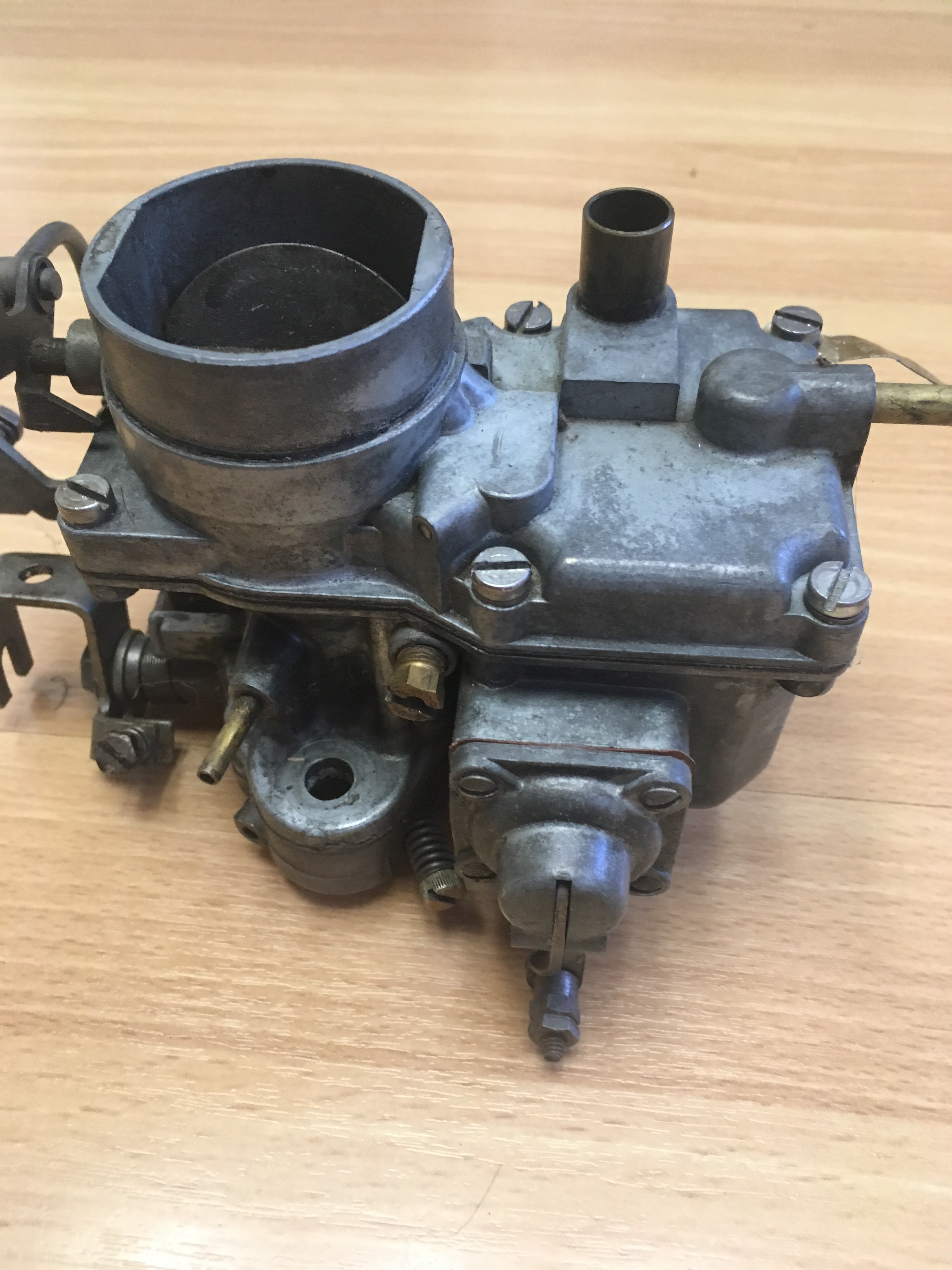
Solex Carb Comparison with a Weber Carb (now including gaskets!)

I quickly took it home and got to work, removing the Solex, unplugging the vacuum hoses and throttle cable, scraping the intake manifold mounting area clean and then… realized I did not order a new gasket. Hadn’t thought about that. It was now after 4pm on Saturday. I borrowed my parents’ car and headed to the car parts store in a mild panic.

There I learned that car parts stores don’t stock gaskets for Weber carburetors — especially for obscure German cars — so I would have to order one, and it would be in by the next weekend. Oops. I kept my parents’ car that week. The following week, with gasket in hand, I mounted it and the Weber on the manifold and bolted it in place. But wait, there’s more.

Re-attaching the throttle cable was easy. But those vacuum hoses? I hadn’t labeled them when I took off the Solex. Oops.

This was decades before the internet, and the Haynes manual did not have diagrams for Weber carbs. The factory shipped them with Solexes, so that was the diagram in the book. And you can see that diagram was no help. 

I did my best, but the engine ran a bit rough — I had clearly misconnected something. 

Luckily there was a wrecking yard in the industrial flatlands of Berkeley that specialized in BMWs. I headed there, and the guy who ran the place, who was in his late 20s, opened the hood and within minutes “cleaned up the vacuum hose hygiene.” I remember that place was loaded with 2002s, Bavarias, and even a few 3.0 CSs. Today those cars — especially the 3.0 CS — are simply unobtanium. To think there was a wrecking yard containing just those cars is incredible.

Later in my car upgrading journey I got new shock absorbers for the front and rear suspensions. I started with the front: I read the manual and realized I would need to get a spring compressor to replace the McPherson strut cartridges. I headed to the auto parts store and rented one for the weekend.

And of course the Haynes manual had diagrams for the front suspension but no real instructions for how to disassemble it and replace the shocks. I spent the better part of eight hours sorting all this out and successfully replaced the right front shock. 

And with everything I learned from that right front unit, I was able to make quick work of the left one, replacing it in under an hour.

I did not have enough time that weekend to swap out the rear shocks, which were super easy. I could do that next Friday after work, before heading up that same night to Lake Tahoe to go skiing. 

This work is pretty straightforward: after you jack up the rear of the car, it’s fairly easy to access where the shock is attached to the lower trailing arm of the rear suspension via a single bolt. The other end of the shock absorber is attached at the top of the top of the “shock tower” through the rear body sheet metal, also with a single bolt. That top bolt is accessed through the trunk, where it protrudes. 
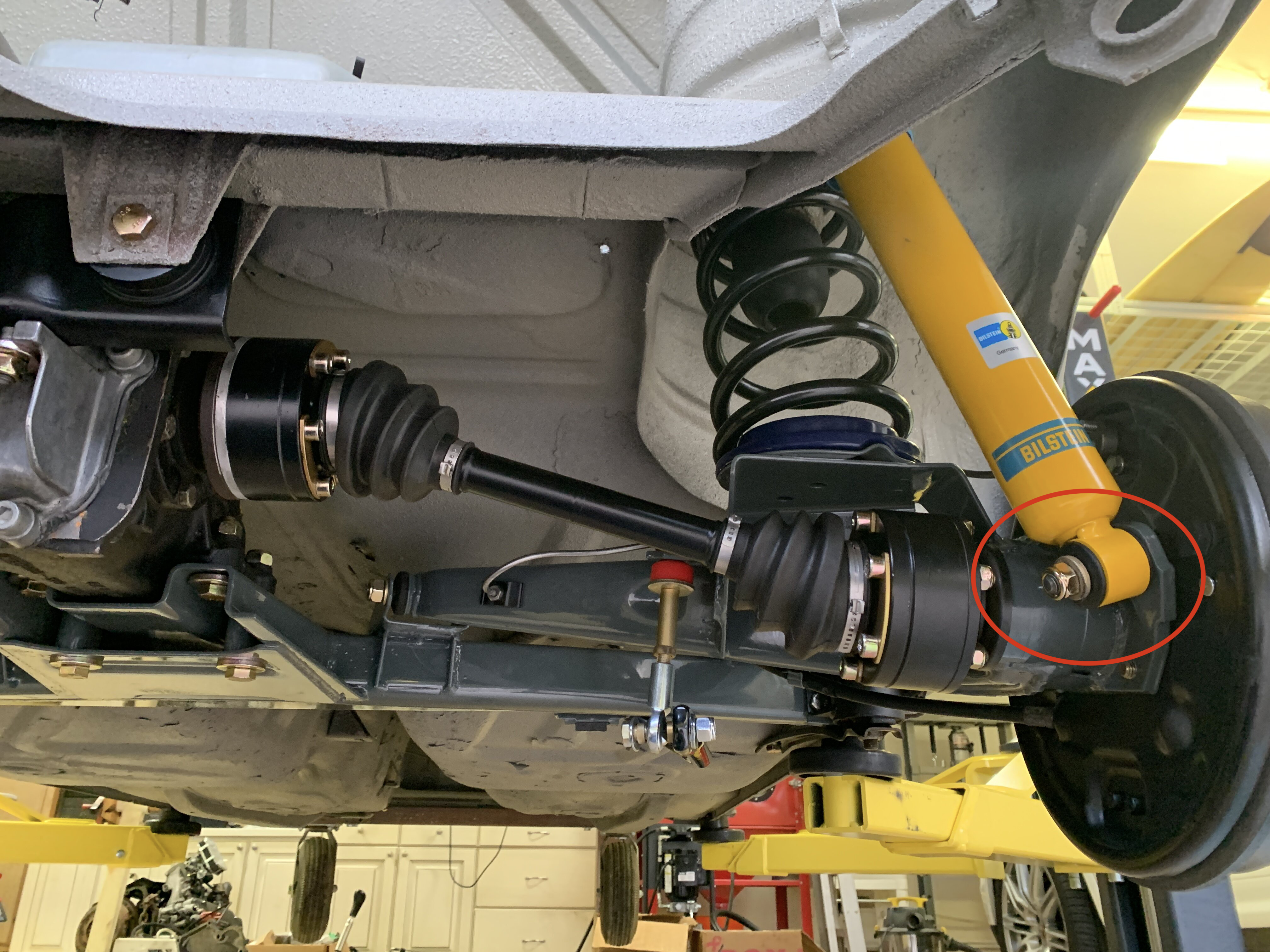
Super easy. I left work early to get home a little before 5pm, and by 6:30 I was on the road to Tahoe. It was dark by the time I left heading out on Highway 80 for the four-hour drive.

As I approached Auburn, I started to hear a knocking from the right rear of the car. I figured I could deal with that when I got to the condo I had rented for the winter. As I approached the mountains outside Auburn, it had started to snow lightly. By the time I was approaching Donner Pass, the snow was less than an inch and not sticking, so nothing to worry about.

But that knocking from the back was getting worse. So I pulled over, got a flashlight and looked into the right rear wheel well and could clearly see that the shock was banging around in the shock tower because I must not have tightened the second lock nut at the top of the shock tower, so both it and the securing nut had vibrated off. I opened the trunk and found the two errant nuts — at least now I could get everything put back together.

First I would need to jack up the right rear of the car, take off the wheel, get the shock back in place, and make sure I put everything else back together.

And as everyone who works on cars knows, the way you take a wheel off a car is to first loosen the lug nuts before jacking it up. It makes it so much easier to get the force you need on the lug wrench and eliminates the risk you’ll pull or push the car off the jack. And you reverse this when putting the wheel back on.

So I loosened all four lug nuts, got the car up on the jack, and went to work.

I was able to get the shock absorber positioned at the top of the shock tower and pushed the top through the mounting hole. My hands were getting pretty cold by then, though. You see I had plenty of skiing gloves, but nothing light enough to do this kind of car work, so I was working bare-handed. It was past 10pm and well below freezing.

I ran around to the back of the trunk, threaded the nut on the protruding shock absorber mounting bolt, and tightened it down, hard. By now my fingertips were getting numb.

I put the wheel back on the car as quickly as I could, threaded the lug nuts on and tightened them, lowered the car off the jack stand, threw all the tools in the trunk, closed it, hopped in the driver’s seat, closed the door as fast as I could, and cranked the engine over, pushing the heat lever to full on and the fan as well. My hands were frozen.

I got back into traffic, and pretty soon I was headed on my way, up and over Donner Pass.

Just after cresting the pass, headed downhill, I felt the right rear of the car drop with a loud CLUNK. I looked in the rear view mirror and saw a rooster tail of sparks arcing into the air behind me. And to my right I saw a wheel rolling past me, getting further away the more quickly I slowed down to stop.

Once the car stopped, I got out and ran around the back to see that the wheel I saw heading down the road was, in fact, my right rear wheel. Those sparks were the suspension scraping the pavement.

Holy crap, I forgot to tighten the lug nuts when I lowered the car off the jack. So I had sped off with loose lug nuts, and the nuts must have slowly worked their way off the lugs.

This was before cell phones existed. The thoughts going through my head then were pretty dire. 11pm on a Friday night, in the Sierras, light snow falling. In need of a tow. But then what? Where was I going to find a spare rim and tire for a 1972 BMW in Lake Tahoe?

Remember, this was the mid 80s, decades before BMWs became mainstream. As important, decades before tech bros took over Tahoe with their BMWs.

So I had no choice. I got out my flashlight to see if I could find… anything.

To the right of the car, the side facing away from traffic, I could just barely see a thin trail in the snow — the trail my tire had made as it fled my car. I followed the trail like a hunter tracking an elk, down the road and down the hillside.

Lo and behold, there it was, resting on its side. Easy to spot, with the light flickering off of those distinctive “bottle cap” wheels I had upgraded to.

I grabbed that puppy, triumphant, and hauled back up the hillside to my car.

But the lug nuts. There’s no way I was going to find those. Not only could they have come off one-by-one over a mile or two, they were the same color as the pavement. And while I had some spare parts with me, no one keeps spare lug nuts.

Then I did the math and realized I had twelve lug nuts on the three remaining wheels. If I took one off each wheel, I’d at least be driving with equally compromised wheel integrity.

So I backed one lug nut off each of the three remaining wheels, got the errant wheel attached with the three lug nuts I had just harvested, and was on the road again.

Ah, to be young and carefree. 

I got to my rented condo well after midnight, and the weekend unfolded as planned. I spent two full days skiing with my crazy friends, and I mean crazy — we liked to jump off the cornice to the left of the Headwall chair at the resort that is now known as Palisades. More on that at a later date.

I drove home feeling somewhat triumphant, having averted disaster while having an awesome skiing weekend. Monday I went to the auto parts store and picked up four lug nuts. Why just four? That’s all I needed, obviously. I would never do something dumb like that again.

Here is the orange 1973 2002 I bought a few years ago. With this car I corrected my poor color choice of my first 2002 and bought one someone else spent their time and energy fixing up. Absolutely crazy fun. 

Everyone should own a 2002. What other car can provide this much adventure and offer so many ways to gain experience? Where experience is “the disaster that didn’t kill you.”

Why the numbers in your operating plan are wrong

December 9, 2008

Startup companies begin life with operating plans – the spreadsheets that outline how revenue will be generated and expenses will be allocated. But in the end it’s all a very well calculated guess. So much is unknown.

A phrase I use a lot when I meet with startup companies is “the only thing we know for certain about your plan is that the numbers in it are wrong”.   It’s a disarming statement, it generally sets everyone at ease.  How could you possibly know what your revenue will be in month 33, when you haven’t even shipped your first product?

And it’s true, in a good way. It’s not the values in the cells that are important, but the set of assumptions and principles that underpin the numbers in the cells that are. I mentioned this in my first post. It sounds and is obvious.

Why bother with the plan? Some CEOs I meet take this path, and use their operating plan as a “check off the box” deliverable on the way to getting funded. But if you go there I think you blow right by critical insight about your business. You need that plan, even when you are far off it, to help you understand which assumptions are still valid, and which may need to change.

An example of an assumptions is “we’ll have larger companies distribute our product for us, and each company will deliver 50,000 end users to us”. That’s important to remember, especially if after six months, they’re only delivering 5,000 users.  It’s even more important to understand if this is just a factor of how long it takes to ramp demand (in which case that assumption needs scrutiny) or of it’s because that’s all the demand these companies can produce for you (ditto).

Your plan is a tool that has a limited useful life, at some point your business (and assumptions) change so much you need to pull out (or rather create) a new one. The right tool, for the right circumstances matters, a lot.

If the right tool is critical, the right mindset produces it. Successfully running a startup requires a resilient open mind and cultivating a sense of intellectually curiosity. You need to want to understand the “why” and “how” the numbers in the cells fail to match reality.

So, examining the failure of your plan, and finding the meaning in the failure, enables you to construct new, more valid assumptions, so you can discard the old plan and create a new one. This can be harder than you think, the plan you have now is was slaved over, polished, and is so “done”. But this new plan has a clearly defined lineage connecting it to the old one, and is the new “right tool” for your business.

Missing your plan is different. Plan “failure” is fundamentally different from missing your plan. Missing your plan comes from poor execution, poor discipline and poor vigilance about understanding why you’re not performing to your plan.  It’s still failure, but failure where no meaning has been examined or made use of.  It’s where you end up using the wrong tool, and not understanding, or even knowing, why you need a new one.

Missing your plan is like trying real hard to use that shovel that worked so well to dig the foundation of a house you’re building to hammer the nails into the framing. Sure it might work, for a while, but over time it’s just not going to do the job you need done. Missing your plan is insisting that you just hit the nails harder and faster with the shovel, and not realizing you hold the wrong tool to begin with.

This is why one of my partners coined the phrase “teams that miss plans generally continue to miss plans”. It’s because they don’t realize its their tool that’s wrong, not their intentions or efforts.

The best CEOs I work with are wonderfully disciplined about creating and appropriately discarding their plans. They measure their performance relative to their plan, and they’re vigilant about clearly delineating the key assumptions supporting the plan. When they’ve measured enough to know the assumptions are no longer valid, they revise their plan, and gladly leave that old plan behind. It becomes all about their new plan, and new tool.

Ego and why it’s over-rated

November 27, 2008

Becoming a VC has had the same effect for me as getting an MBA – it’s provided me with a label that has opened some doors.  But a label is different from substance, it’s thin, and sticks to the clothing you’re wearing. Under the clothing is you.

I’d never been a VC before and it felt very much like a very fast race, but where I was learning the event and the course as I went. So much to learn about the business of evaluating embryonic, wildly ambitious businesses as well as learning the mechanics of investing other people’s money.

Then again, this is a lot like every job I’ve ever had. In every startup I’ve been in, we were creating an entire new category in the market. No one had a playbook, no one had studied this before. Yet, we had a business to run, and customers to keep happy. We wrote the rules, we led our teams, in real time.

About 15 years ago, right after business school, I worked for a high powered management consulting firm in Boston. I managed a small group of undergrads, and we worked with large firms on tough strategy problems. It was intellectually rigorous and obsessively methodical. It was very much about the essence of management: establish a plan, direct a team, measure results. You operated with a playbook you carefully constructed as you went along.

My team? All recently minted undergrads, and so, so much smarter than I was. At various points I managed Steve Levitt (yes, Freakonomics), Glenn Berger, Russ Wilcox, and Greg Sands. But all I was focused on was how their smarts compared to mine, and as a result I quickly lost my ability to direct them.  I lost my ability to let my experience and perspective provide a framework and direction. My ego, fed with insecurity, became this huge obstacle to success.

In about 18 months, it was clear I was failing. I was repeatedly counseled “forget about how smart they are, they need the direction that your experience can provide them”. But I couldn’t. I’d like to say I failed “spectacularly”, but there’s never anything spectacular about consulting firms. I failed quietly, by being told I would have three months to find a new job.

With hindsight I realize I lacked the confidence to accept what I knew and didn’t know, I thought I had to know everything, and if I didn’t, I spent a lot of time and energy trying to create the illusion I did. All that energy got wasted and prevented me recognizing and embracing their talent, and I couldn’t focus on the pleasure of enabling and directing their effort and success.

So in the first few months in my role as a VC, I had almost an out-of-body experience. I could see where I could go back down that path of ego-as-obstacle – so much I didn’t know, so many people who knew so much more. But this time it was different. I had the accumulated scar tissue to “let go”, to seek and embrace that line where I knew what I knew and where I didn’t.

This time there was an added twist.  This is an industry where a very few people have made enormous amounts of money by helping to create groundbreaking new companies. But the other 98% of us? We haven’t. That “aura” is thrust upon you, projected on you by the people who seek your advice and your funding. It’s easy to let that define you, to let that inform the ego you present to the outside world.

So, I love knowing that if I’m lucky, I will meet and work with people smarter and more capable than I am.  I also love knowing that I haven’t yet made billions in this business.  I still believe I’m really good at it, and enjoy it.  But it’s a heck of a lot lighter meeting with entrepreneurs and co-investors, comfortable in the skin I am wearing.  We’re all a lot more effective, and at ease.

So, I love having no ego in this business. For me, ego is different from being smart, experienced, and helpful. You can be all those, but you can be those in a way that meets people in their comfort zone on their terms, not yours.

Meaningful Failure

November 27, 2008

In my world as a venture capitalist and a veteran of four fairly successful startup companies, I see and have experienced failure, a lot. My colleagues and I talk about it a great deal, in familiar ways and in ways that assign value to failure that occurred in a meaningful way. With the big ideas and within the teams that build companies around these ideas, modest success is simply not valued as highly as failure that occurs while attempting something bold, new, and ambitious.

Outside of my world, failure is spoken of in ways that make me think the people doing the talking view failure more superficially than we do. It’s a pause on the way to success, something you move on from. It’s as if failure is treated as a currency that gets spent on the way, but it’s a currency that’s been in circulation too long; it’s grimy, and you don’t really want to touch it if you can help it.

In the ”sky’s the limit” world of startup companies it’s all about being in a place where you’re brave enough to go do something new and bold and the only thing you are scared of is not succeeding. My colleagues and I frankly spent less time worrying about the failure side of our businesses than we do understanding what the obstacles to success are. We know failure is going to happen. In those early days of our companies, in fact, one of the few things we know is that the plan will end up being wrong, or at least that the numbers in all those cells will be. But understanding why they are wrong – examining, seeking the knowledge of where we failed – is how we find the path to success.

It’s not that we’re in love with our failures, but we do have meaningful relationships with them.

Meaningful failure. It’s not just where things didn’t work out. It’s failure that happened even when you were really, really motivated for and focused on success. It’s that confluence of ambition and reach, hard work and commitment, preparation and talent; where all of that comes together, and it’s still not enough.

It’s why most of us have an iPod while we also still use Windows computers; Apple sure failed to get the Mac mainstream, but learned from that when they entered the music and phone businesses.

But this is a really big failure. What about the failures we all experience in our jobs and personal lives that happen on a very human scale. You can have ambitions, you can place yourself in uncomfortable and vulnerable positions in order to achieve something of importance to you, and still you can fail. In fact, if you accept, even embrace failure, then about all you can control is how you respond to it when it happens, and what you take with you to as a result of it.

I like the analogy of failure being the lubricant in the engine. Without it, the engine stops. Without the meaning from the failures we create and encounter, the engine of success will stop. Or rather, when success happens it will be a lot smaller. Failure can tell you why what you hoped would happen didn’t but also why something like it, or better, can and will. If you’re not experiencing failure, then, perhaps you’re not hoping with enough ambition. Embracing it, anticipating it, being resiliently open minded, well, that’s just being a good steward of a high performing engine.

That’s why when I describe what it’s like to be in a high octane startup I refer to it being in a place where you remain calmly focused on the very few reasons why you will succeed and not on the seemingly thousands of reasons why you might fail. You’re striving for performance towards the big goal, not results of any specific setback along the way. It places you on the balls of your feet, not your heals. You know failure’s bound to happen, so lean into it.

It’s as simple as shifting your perspective to a “fear of not succeeding,” which is fundamentally, and in a very nuanced way so much different from a “fear of failing.” By focusing on what it takes to succeed, you can embrace the fact that there will and should be many junctures involving failure along the way. It’s the focus on success that enables you to get the big things done in life.

But embracing failure and extracting the data isn’t enough. You need a resilient, open mind to care for and make use of what you learn from your failures. Resiliency is important; it provokes a stretchiness and adaptability of your frame of reference and enables you to let go of that firmly held set of assumptions developed yesterday in order to embrace a better, more informed set today.

I like to think of my life as living in a continuous startup. At some point along the way, I realized that it’s at the moment of failure where the real meaning is, where you can figure out both what you are deep down inside and then how to be a different, more capable you the next time. That in order to be living a life of meaning and value, failure has to be not just acknowledged but embraced as the missing ingredient to success.

When you’re busy being focused on how you’ll succeed and failure occurs, it seems so much simpler to look at what just happened as fodder and information to take another run at finding out how to succeed the next time. It may be that the “next time” is the next iteration of the business you run at your company today or a totally different business at a totally different company. The constant, however, is standing at a juncture of success, open-minded learning, and meaningful failure and being ready to take the next step.